
July, 2015

The Manta ray night dive is Hawaii’s signature dive and snorkel. It’s consistently rated as one of the top ten dives in the world. In no other place can you see Mantas as consistently, in numbers, and up so close and personal that they will pass within inches of you. Exciting and visually stunning, this dive will stay with you forever.

The Manta Ray Night Dive takes place just off shore from the Sheraton Keahou Bay Resort, at a site that divers call “Mantaville”, for obvious reasons. Indirectly, the divers are actually feeding the Mantas with their lights. The divemaster places a crate of divelights- the “campfire”- in an area of sand with surrounding corals in just over 30′ of water. This, with the aid of the other diver’s lights attracts plankton, which is the primary food source of Manta rays. Over the years, the Manta rays have become conditioned that this is a favorable feeding area.
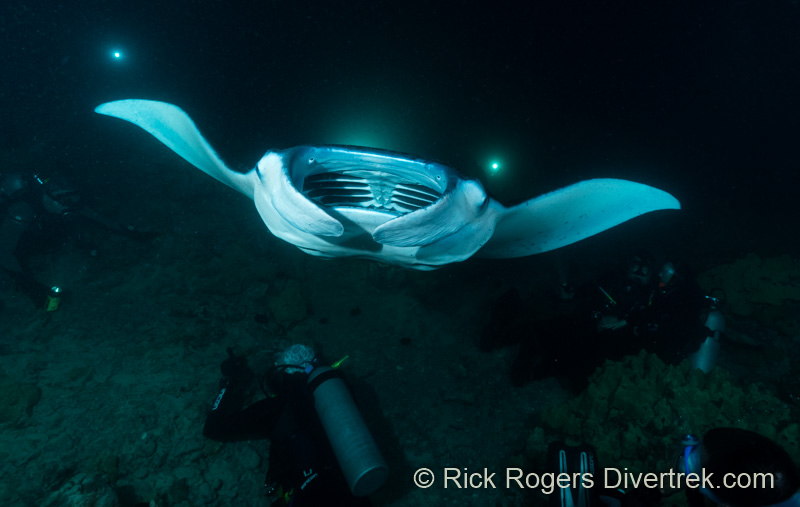

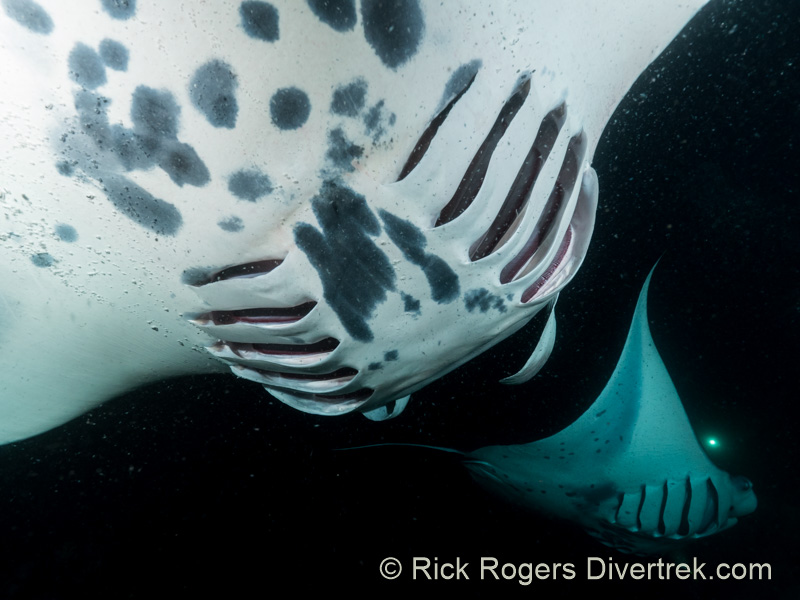
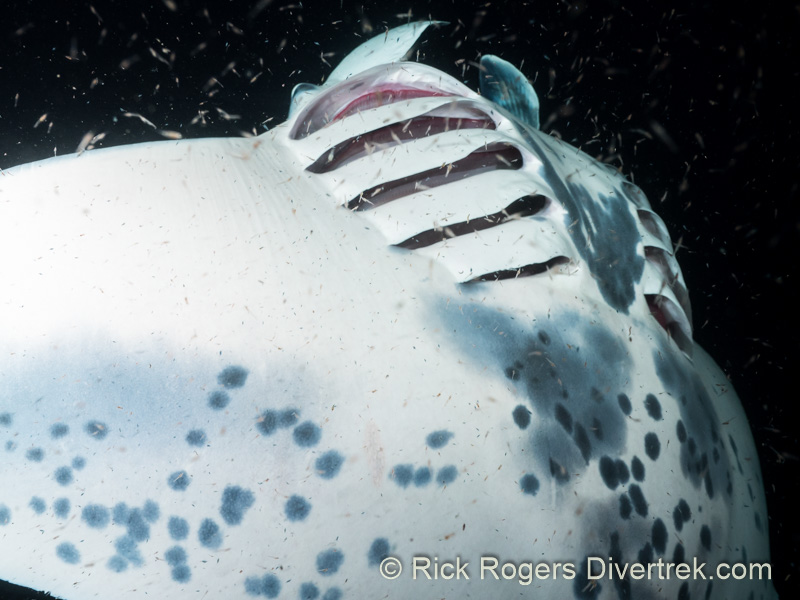
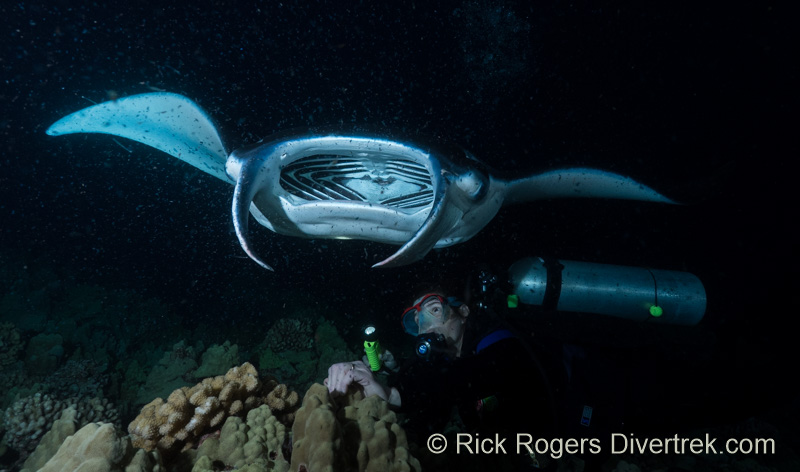
The black markings underneath each Manta are unique, similar to a fingerprint. This enabled me to look-up the injured Manta shown in the picture below at an advocacy group (http://www.mantarayshawaii.com/manta-rays-library/lefty) that studies the local population. Their site is well worth the visit, and contains interesting videos, pictures, statistics and information. Her name is “Lefty”, and she was first identified back in 1979, about 35 years ago! She has a paralyzed left Cephalic fin, and the scars shown on her left wing are from a propeller strike.

We were in Hawaii to do a week of diving aboard the Kona Aggressor II liveaboard. Capt. Karl wanted us to do this dive early in the week because of concerns over incoming swells that might make some difficult surge at the dive site. I think a lot of other people had the same idea, because the area was filled with boats. I counted 15 boats in just my periphery at the dive platform! But most of these were snorkelers. They float on the surface on rafts equipped with huge blue floodlights that shine down to the bottom. On the way down, it was an awesome sight to see Mantas performing long graceful arcs and barrel rolls in these huge light beams, vacuuming up the plankton as they swam.

On one hand, having this large number of divers and snorkelers is a good thing because more light equals more Mantas (four of them continuously circled our vicinity). And all of these lights literally turns the night into day underwater, giving it the ambiance of a rock concert, or a Sci-Fi movie. In fact you will be able to take satisfactory pictures without using strobes, as some divers did. But as you might expect, more divers makes it more difficult for photography as more silt gets inevitably stirred up, and the larger quantity of exhalation bubbles spoiled some of my photos, along with it appearing as “pixelated noise” in the background black of some others.
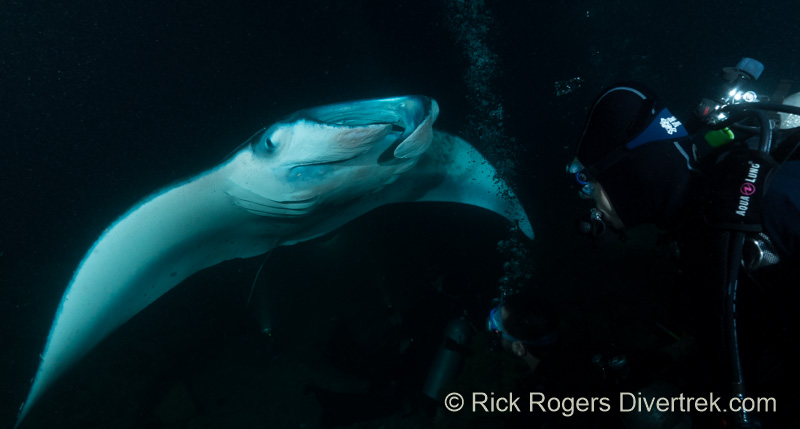
The whole dive lasts about 45 minutes before the signal is given to begin making your way back to the boat. But it seemed like only 10 minutes had passed. One Manta dive wasn’t enough! So a few days later, the majority of us voted to do it all over again.
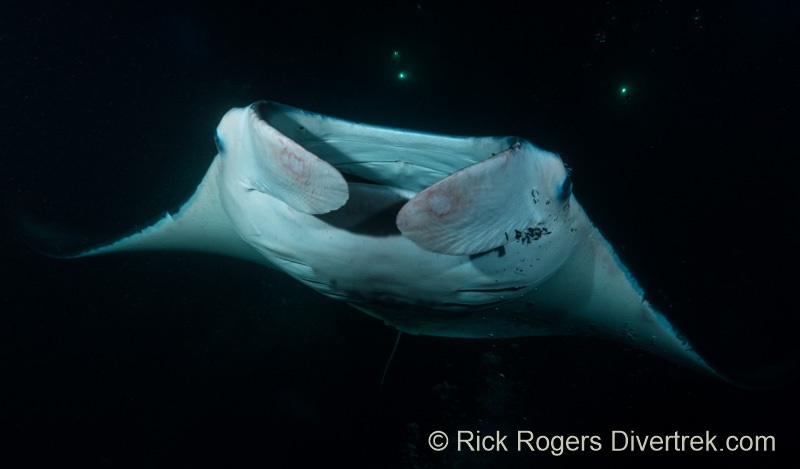
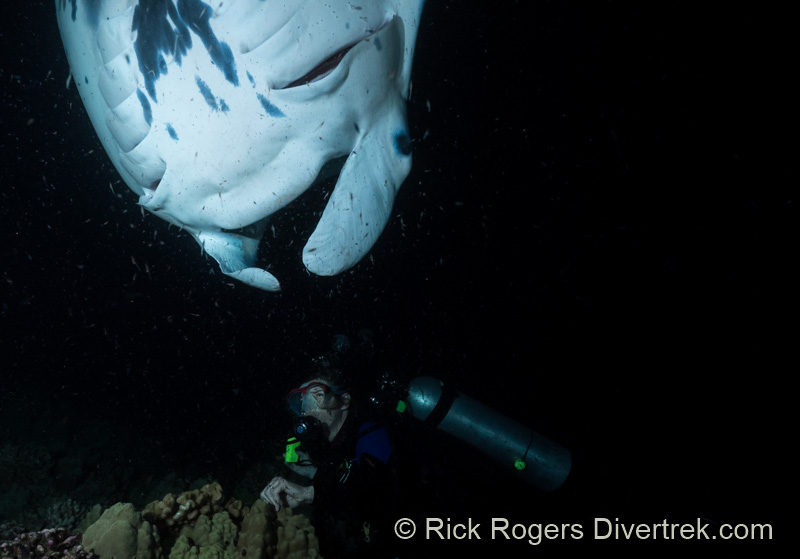
The second dive was much different than the first. There were fewer boats, and less lights, and therefore fewer Mantas. But it was a much more intense, personal and serene experience. The one Manta that stayed with our group came much closer than what they had during the first dive. And it just looped back and forth between our upward pointing dive lights, performing barrel rolls and graceful sharp turns, passing within inches (and even sometimes closer!) of us.
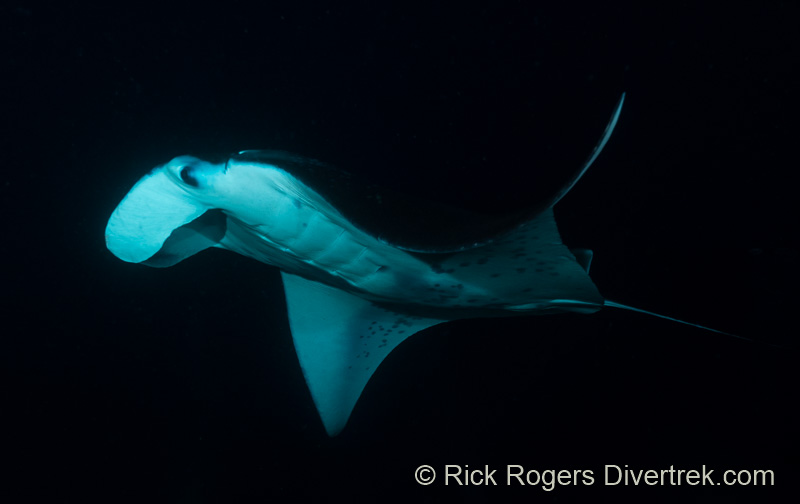

It seemed that with fewer lights to gather around, the plankton food chain concentrated to the point where it actually felt as thick as a blizzard on my hands. The result was that the Manta spent more time around my light, giving me a personal show:
Seeing is believing, so here’s a short video that I made of this second dive. Danny, one of the guides who has led countless Manta dives, said that he preferred this more personal and peaceful experience that we had:
Some purists might argue that we are “feeding wild animals” and altering their natural behaviour. But I see it through a more realistic and practical lens. These Mantas contribute many millions of dollars a year to the local economy, and thus provide an incentive for their preservation, even inspite of their protection under Law. In other parts of the world, Mantas are harvested for their gill rakers, dried up and then used for nontraditional medicines. In parallel, shark ecotourism has demonstrated to locals that they are worth more alive than dead.
Tips:
There are two Manta sites at Kona: one up by the airport called “Manta Heaven” (divers call the site “Garden Eel Cove”) and the other described here at “Manta Village” or “Mantaville”. The tours take place 6-7 days a week, year round, weather permitting. These are wild animals, so they come and go as they please. Manta Heaven reputedly gets more Mantas, but is not as consistent with “show ups” as is Mantavillage. The water temperature according to my dive computer was 81 deg.F.
If you go for a day trip, please choose a responsible operator for the Manta’s safety (and yours). Manta Ray advocates publishes a Green list of activity providers that follow industry standards (and linked to a checklist of what they offer), as well as a free e-book “The Free Guide to the Manta Ray Experience in Kona, Hawaii” to help you get the most from your tour.
Since I was photographing fast action at night I was worried about focusing issues. So I “locked off” my focus on a coral head about 2-3′ away and used a more generous depth of field of f/10 (especially for close passes). That way I could just worry about composition. I used an ISO 640 to allow for fast strobe cycling, and a lower equivalent exposure (to help with backscatter), which allowed me to lower the output on my YSD1 strobes to about zero. I set an exposure of 1/200 s to allow in some background light and yet still capture those close passes with all the ambient light present. Back scatter is a major issue with this dive, so I placed my strobes out and pointed outwards to deal with the particulates.
If this dive isn’t on your bucket list, it should be!
Related Articles:
Diving the Kona Coast, Hawaii, aboard the Kona Aggressor II.