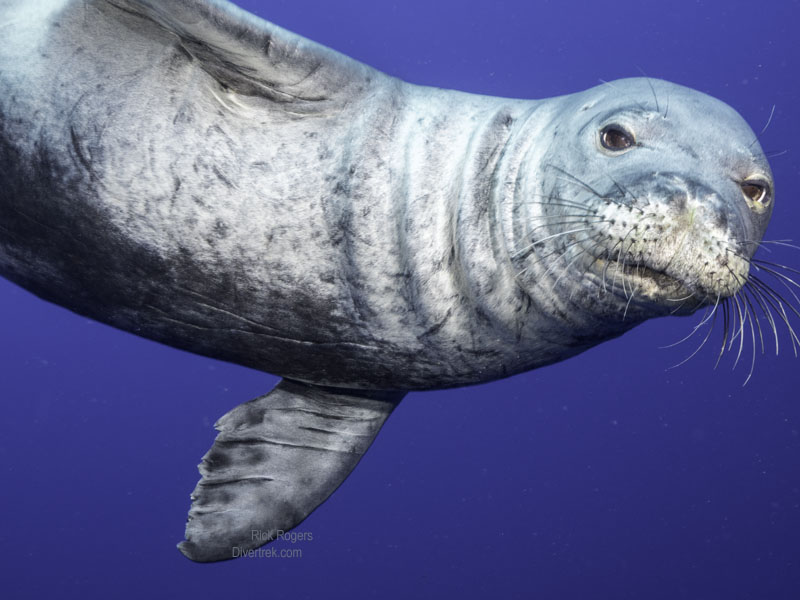
One of the rarest of marine mammals, the endangered Hawaiian Monk seal, looks curiously at his reflection in my camera. Photographed at Lehua Island, near Niihau Island, Hawaii.
July, 2024
Kauai, the Garden Island of Hawaii, offers the highest concentration of Green Sea turtles that I’ve ever experienced. It’s also a gateway to Niihau, the remote “Forbidden Island”, where divers go to dive with the endangered Hawaiian Monk seal. The island’s powerful natural beauty also offers much for the outdoor enthusiast to explore.
Part of the propeller shafts of the Cristobal Colon wreck. At nearly 500′ in length, the former luxury liner is the largest in Bermuda, and divers could easily spend hours exploring the remains.
June, 2023.
Renowned for having the highest concentration of shipwrecks per mile worldwide, Bermuda has earned a prestigious spot on National Geographic’s list as a must-visit diving destination. It boasts an abundance of 300 relatively shallow wreck sites, vibrant fringing reefs, a unique system of historical forts, and limitless topside activities. Discover why Bermuda deserves a spot on your short-list.
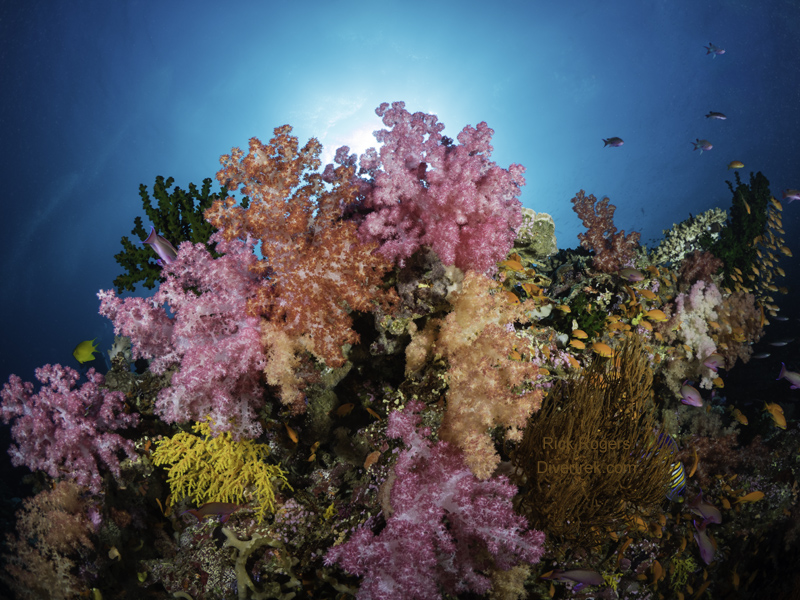
Morning sunrise over a beautiful Fijian reef . The soft corals here are so lush & colourful that you quite often won’t know which way to point your camera!
July, 2022.
Fiji has a well known and deserved reputation as the “Soft Coral Capital of the World”, and easily ranks within the top five coral reefs to dive. This trip focuses on the main Island of Viti Levu on the Bligh reefs (yes, that Bligh!) in the North, and the famous Beqa Lagoon shark dive in the south.
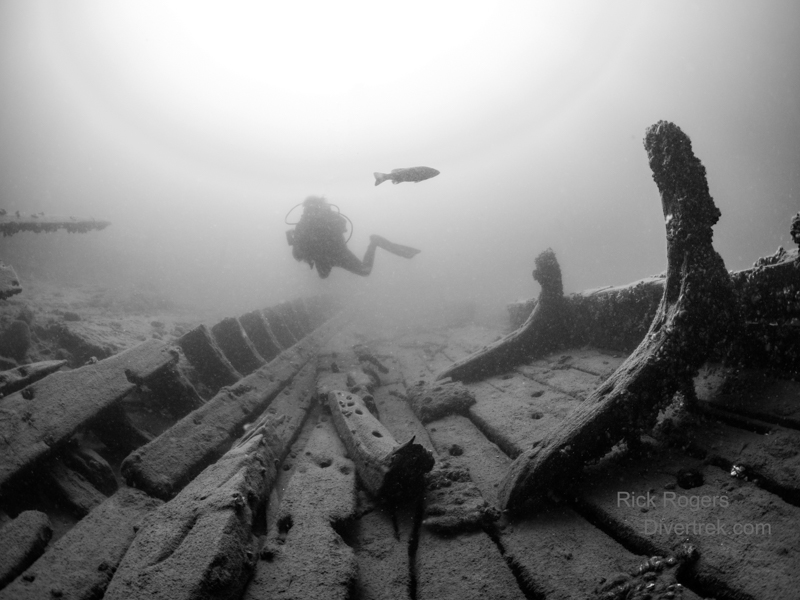
The anchor of the Mapledawn wreck near Penetanguishene, Georgian Bay, Ontario.
August, 2021.
Southern Georgian Bay near Penetanguishene (“Penetang”) has some of the most interesting and photogenic wrecks in the Great Lakes. Two of Cris Kohl’s “Top 100” ship wrecks are located here, and explored in this post. Accessible to all skill levels, and in warm, clear waters, these are just simply fun wrecks to dive.
A Great White pursues a Tuna bait at Guadalupe Island, Mexico. Taken on the last day from atop the “Shark Wrangler’s” platform, it was one of only three that we saw.
July, 2021
Guadalupe Island is a well known White shark congregation site, located about 240 km off the coast of Mexico’s Baja California Peninsula. We were one of the first ones to arrive at the biosphere reserve since it was closed due to Covid-19 for nearly a year and a half. Our anticipations were high. Being in the water with the Ocean’s largest predatory fish had been on my bucket list for a long time.
Exploring the wreck of the Jane McCleod, a 19th century schooner. The “L-shaped” bracket structures seen at right on the inside of the hull are the ship’s “knees” which once supported the deck beams.
August, 2020.
Parry Sound is located on eastern shore of Georgian Bay, the northeastern arm of Lake Huron, and informally referred to as the “sixth” Great Lake. Set among the ruggedly beautiful 30,000 Islands, you’ll enjoy the scenic boat rides, and its inviting waters and shallow wrecks are suitable for new or advanced divers alike.
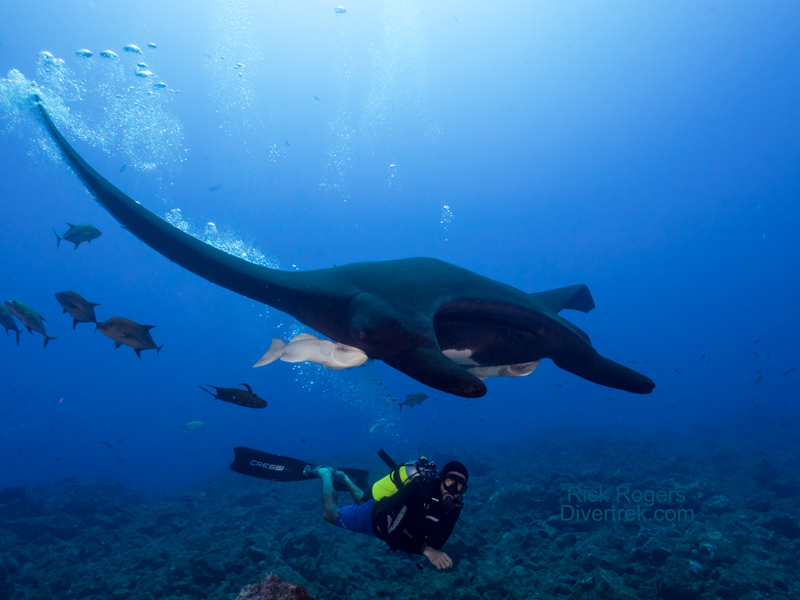
Gentle flying giants. The Oceanic Manta Rays at the Revillagigedo seek out interactions with divers, and particularly like their exhaust bubbles. They apparently enjoy the “tickle” against their skin.
January, 2020.
The Revillagigedo Archipelago- or more commonly, Socorro islands- is a group of four isolated volcanic remnants about 400 km (250 miles) Southwest of the Baja California peninsula in Mexico. The islands are like an oasis in the desert of the open ocean, attracting life, and supporting their own unique ecosystem. It’s the largest fully protected Marine Reserve in North America.
Rightfully known as the “Mexican Galapagos”, people from all over the world come here for their famous Giant Manta Ray, shark and dolphin encounters. Having heard a lot of good reports from other divers, I had to go see for myself.
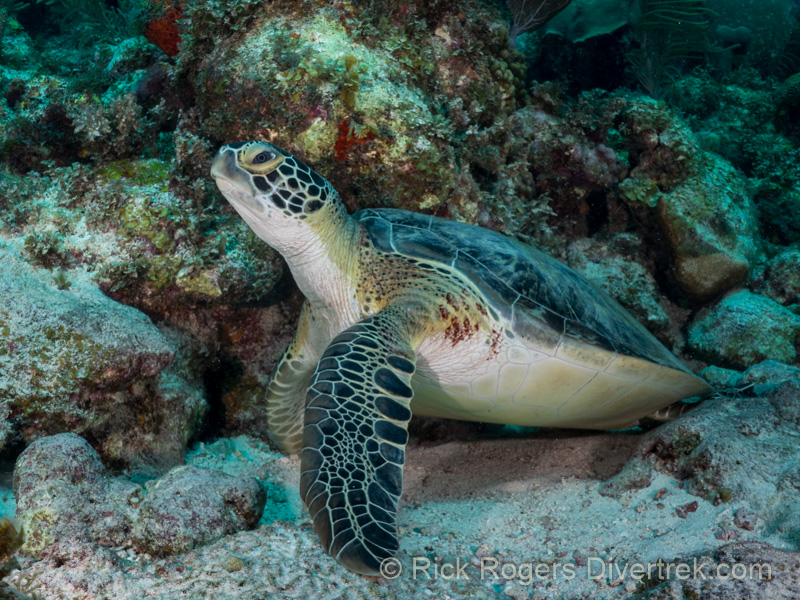
A Green Turtle at “Turtle City”, one of 40+ that we saw on a single dive.
January, 2019.
East Coast Diving takes all of the elements of the best dives on the West side-where divers normally go-and combines them into an exclusive handful of action-packed dives that are only accessible by boat. You’ll love the thrilling boat rides, great reefs, wall-to-wall sea turtles, and other pelagics.
A teeming, colourful, and diverse boquet of life. Photographed at the Outer Narrows near Seymour Inlet, N.Vancouver Island.
August, 2018.
Northern Vancouver Island has a reputation for being among the best temperate diving in the world. National Geographic has recognized the area as one of their ultimate adventure bucket list dives due to the density and diversity of life found there. Many of the dive sites here are world renowned, such as the Browning Wall, and the Nakwakto Rapids. From whales to macro critters, this place has it all.
Emma, a 15′ Tiger shark, introduces herself to me at Tiger Beach. She’s one of the superstars there, and a personal favourite of Jim’s, an now of mine too.
July 2018.
Tiger Beach is a shallow bank made-up of sand and patches of coral reefs, about 25 miles North West of Grand Bahamas Island. It has gained a reputation among divers for reliable, close-up interactions with Tiger sharks in crystal-clear, calm, blue water. But you will also see loads of Lemon sharks and Caribbean Reef sharks. You will leave a different person, and with a new appreciation and respect for these apex predators.