

July, 2021
Guadalupe Island is a well known White shark congregation site, located about 240 km off the coast of Mexico’s Baja California Peninsula. We were one of the first ones to arrive at the biosphere reserve since it was closed due to Covid-19 for nearly a year and a half. Our anticipations were high. Being in the water with the Ocean’s largest predatory fish had been on my bucket list for a long time.

“Where are all the sharks?” I asked.
“This isn’t science- just my opinion- but I think that the sharks aren’t used to approaching the boats anymore like they used to be. They need to be retaught”, suggested the divemaster. It seemed to make sense. But of course it could’ve just been that at the beginning of the third week of July 19th-21st we were still a bit too early in the season (see linked articles 1, 2 below). July is reputedly the month were the “testosterone fueled” juvenile males begin to congregate and compete before the larger females arrive in autumn for mating.
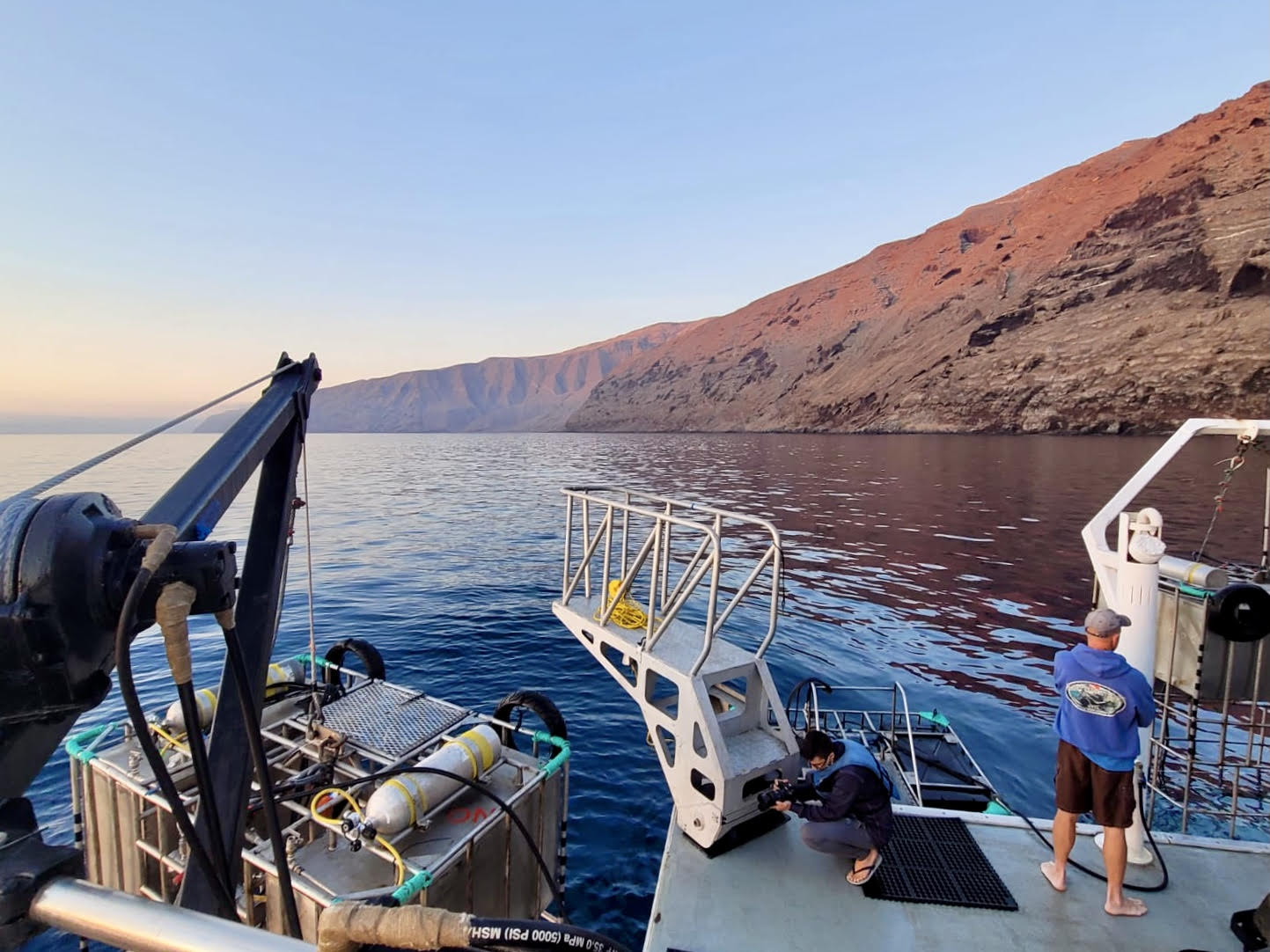
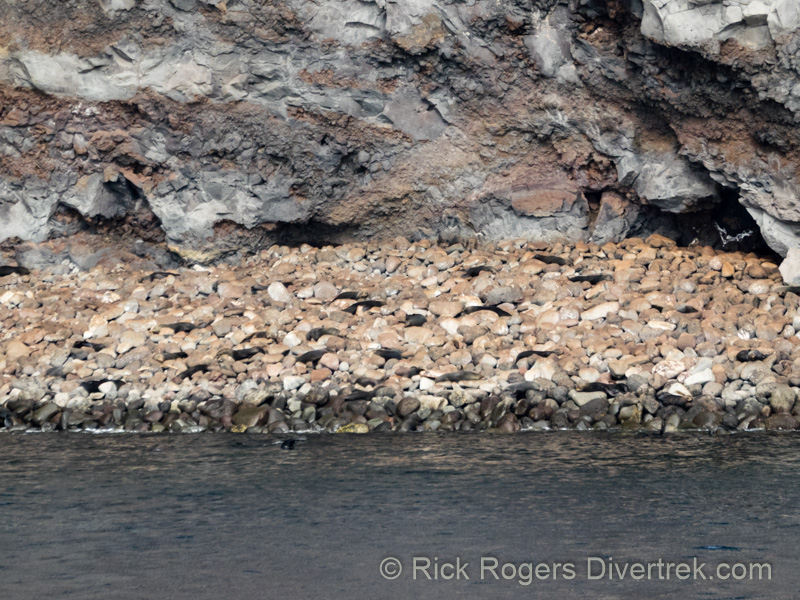
However the shark sightings were scarce. On the first day one Great White showed up for a few minutes on the surface. The second day I saw one from the top deck swim alongside the boat and right past the tuna bait without stopping. On the third day we only saw one Great White at the end of the day for about 45 minutes with about 15 mins of continuous action according to my camera time stamps, before we were to return to the mainland.
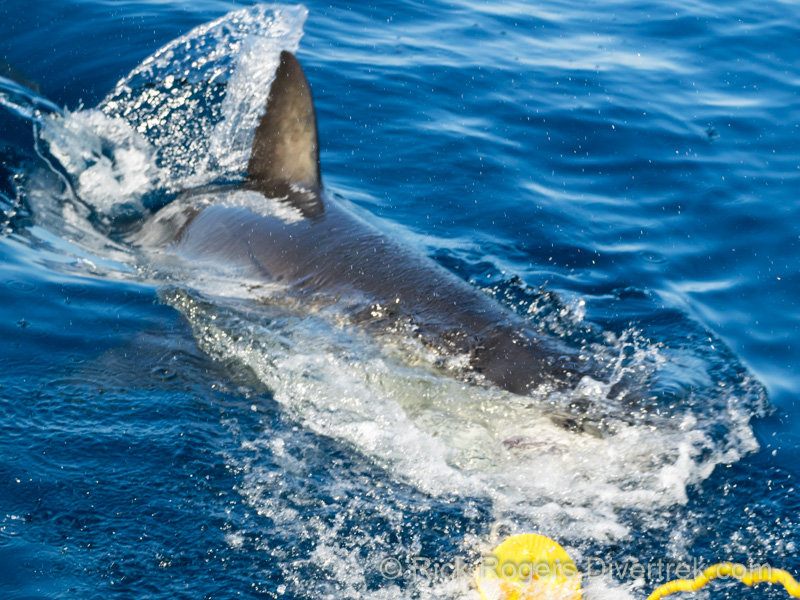
It seemed that the shark sightings were typically in the late afternoon (as reported from their sister boat), and they had been approaching from the island-side of the boat during our sightings. So on the last day, I picked the appropriate surface cage, on the island side, crossed my fingers and jumped into the cage alone for as long as I could bear it.
I placed my back to the cage so I could keep an eye on both tuna baits, on the aft port and starboard sides. All day long these “shark wranglers” toss the bait in the water on a floated line, and then pull it back to the boat, trying to attract the attention of a nearby shark. Then after 2 hours of patient waiting it happened. The image burned into my mind forever, the massive hulk of a Great White materialized out of the blue on the other side of the boat, charging the bait. But it was on the opposite side of where I was anticipating (the ocean side) and too far away for a good shot.
Immediately then excited divers began jumping inside the cage with me. But as luck would have it, the current was blowing in the direction of the shark, carrying all their exhaust bubbles forwards toward the shark (as you can see in the pic below). A wall of bubbles. The shark made only one pass at the side I was on, and didn’t stay long before turning his attention back to the far right bait.

When the shark crossed over sides I think it was attracted to the white diffusers on my strobes as it made a slight charge toward me, but turned away when I pulled the camera back inside the cage. I was very mindful of a photographer on a previous trip who had lost his big rig when it got caught on the bars as he pulled it back inside (it sank to the bottom)!
It’s amazing how fast 45 mins can pass when you’re excited, as it seemed like only minutes had passed, when a loud banging on the bars disrupted my focus. The captain was telling us to come out, as we had already overstayed, and was were running out of time to stow away all the cages and equipment before setting back.
Although this trip didn’t turn out as I envisioned, with not nearly enough shark action, I still felt some gratitude that I had at least seen and shared the water with the world’s largest predatory fish- albeit in a cage. But I still wanted that eye-to-eye contact that I never got. What did I learn about Great Whites from my limited time with them? They were cautious, and only seemed interested in the bait that was offered to them, paying little attention to the divers standing inside the cages. A far cry from how the popular media likes to portray them.
This “bucket-list” trip still isn’t crossed off the list!
- Fine-Scale Habitat Use By White Sharks at Guadalupe Island, Mexico.
- Migration patterns of White Sharks Carcharodon Carcharias tagged at Guadalupe Island, Mexico, and identification of an Eastern Pacific shared offshore foraging area.
Tips:
The water temperatures were 68-70 degrees, and my 7 mm wet suit with a 7 mm core warmer was perfect. Divers wearing 5mm suits often exited the water cold. Better yet, bring your dry suit if you have one, as I found out that they have a LP hose inflator attached to one of the tanks in the cages. The camera ports on the cages were a bit small, and my 4/3 camera barely fit through the opening with some wiggling. This is the result of the much publicized 2019 incident of the shark that got caught in one of the openings and sadly lost its life. The openings were also placed a bit too high for me (I’m 5’7″) which made me stand on a lower horizontal bar and brace my knees in the corner to stabilize myself.
You’re guaranteed at least 3 dives a day in the submersible cages (20′ depth), with unlimited time in the surface cages, space permitting. But from what I saw, all the action was at the surface cages, where the bait was. All you need to bring is your mask, gloves, and exposure suit. They use a “Hookah” regulator system with hoses attached to a secondary from a central compressed air storage. The charge is $50 USD to use their regulators, and are introductory in terms of quality. Bring your own secondary if you can. They also use a convenient harness-type weighting system that you put on to make you negatively buoyant in the cages.
Another point to keep in mind is the availability of natural light for photography. Later on in the season you’ll get less hours of daylight, especially as the sun sets behind the tall, kilometer-sized cliff of the Island. The water visibility varied tremendously from about 100′ (as I could nearly see the bow of the 135′ long ship) on the first day all the way down to less than 20′ on the second day (from SE swells).
Bring sea sickness medication for the open crossings if needed. We encountered 8 foot waves on the return trip. Many people missed meals on the way back.
Travel through San Digeo if possible. We had to travel through Mexico as the USA land border was closed on the USA side. This added a considerable expense and extra fly time.
If you require a PCR test to fly home this can be arranged through the ship for the last day of the trip before disembarking the boat. Cost was a steep $175 USD each as it was a 2 hour test turnaround.