

Aug 2-3, 2014
Lake George is a prime resort area located in upstate New York, in the Adirondack Mountains. Looking at it today- with all of its tourists, boaters and select resorts-its difficult to imagine it as the focal point of a desperate struggle between France and Britain for Empire, during a time period called the French & Indian War (1755-1763). This was the time and place that inspired James Coopers’ famous novel “The Last of the Mohicans”. Hidden beneath its waves from casual view is a time capsule from that very time period- “North America’s oldest intact warship”.

The Smithsonian Institution recognized it as such in 1995. And it’s remarkable to see for yourself. A 256 year old intact warship frozen in time, virtually untouched from the day it was deliberately sunk in October of 1758 to hide it from marauding French forces beneath winter ice. The “Land Tortoise” Radeau (French for raft, a class of warship) was built to be used as a floating artillery platform. It was fitted for 7 cannons, and could maneuver into shallow water to attack targets and support an amphibious troop landing.
This particular sunken Radeau was supposed to be retrieved the following spring to attack the French and dislodge them from lakes George and Champlain (at Fort Carillon, or later, Fort Ticonderoga). But it came to rest in much deeper water that intended when they sunk it. Their misfortune was our gain.

When the ballast stones were added to scuttle the ship, perhaps unequally or due to a shift, it is believed that the ship gradually planed out to much deeper water, eventually settling in at a depth of 107′ . The following spring, the ship was much too deep to be reclaimed by the British and American Provincials. So there it laid, in cold-storage, waiting to be discovered by a side-scan sonar survey of the lake in 1990.

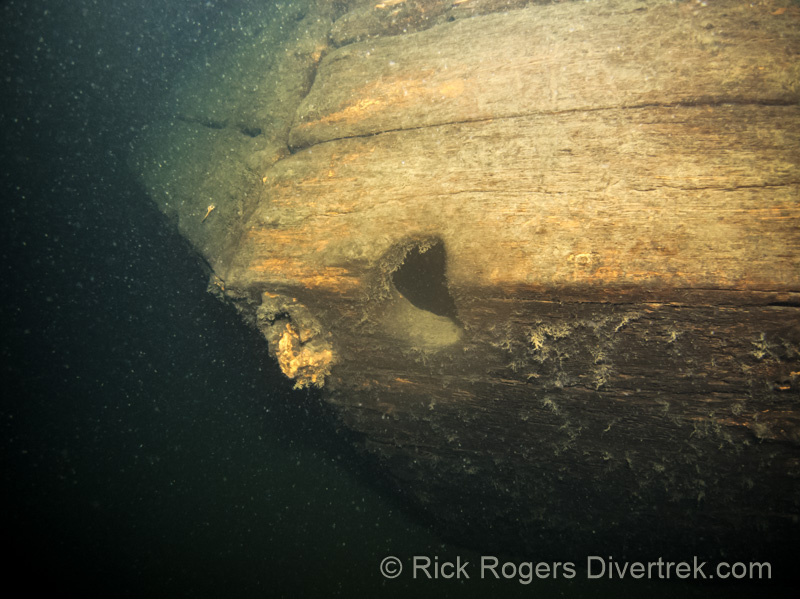
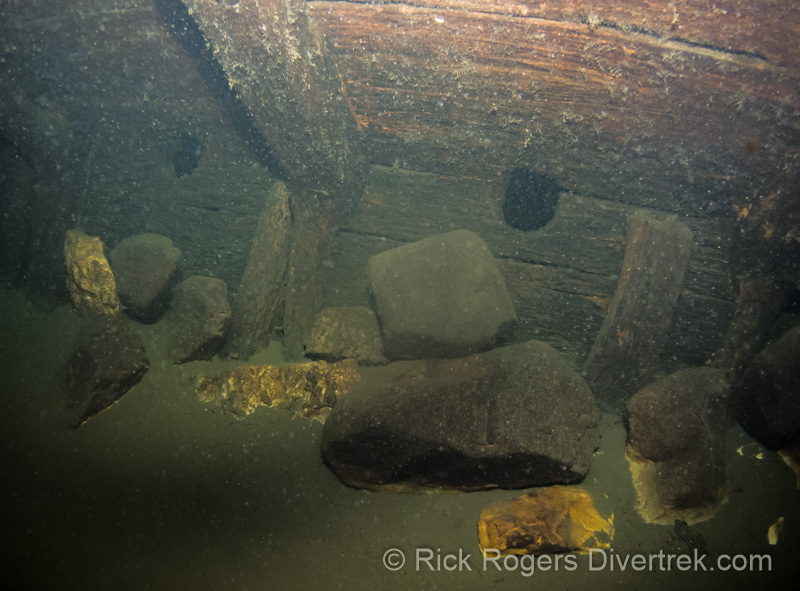
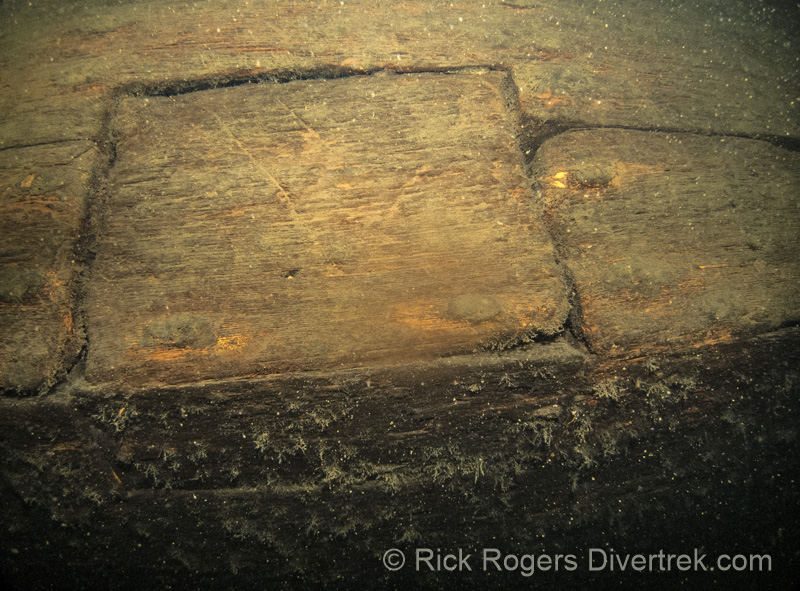
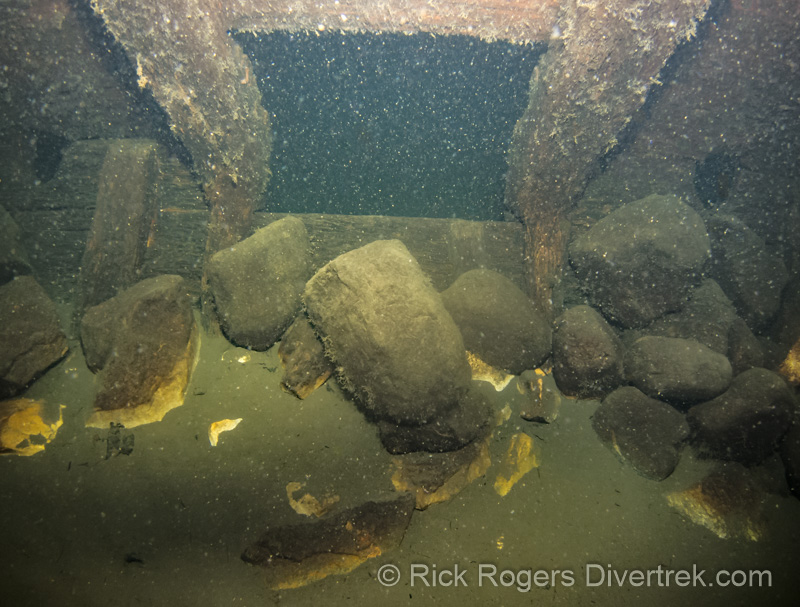


 The dive site was darker than I had expected, so a flashlight is a must. It also had alot of suspended particulates in the water (due to all the motorboat traffic and recent rain?) . The visibility was about 20′, with the average I was told about 25′. There are two thermoclines to pass through. The water temperature at depth (107′) was 45 deg.F, and can vary anywhere from 35-45 deg. F depending on the time of season. We were reminded to watch our fin etiquette, as the light silt layer (which now protects the wood, let alone the visibility) is easily disturbed. By law, we were required to each carry an alternate air source on this dive (you can rent a pony bottle from Frank, the captain, for $10, if you’re using a single tank).

For the afternoon dive we did wall diving at Kurt’s Playground (or alternately, Curly’s Reef). The whole Lake basin is made of limestone which has been carved out into interesting shapes, with cracks and some swim throughs. With some imagination, some of the boulders and rocks resemble animals such as “Alligator rock”.

The next day we dove the “Forward” a shipwreck that is also listed on the National Register of Historic Places. It’s the most dived of the wrecks here. It was built of wood about 1906, and is 45′ long, about 8′ wide, and just over 4′ high. It sits at a depth between 37-42′ of water, East of Diamond Island. It was one of the first boats to be gasoline-powered, and its engines are easily visible on the wreck. It was originally owned by William L. Bixby of Bolton Landing. Interestingly, his son Harold was a chief backer of Charles Lindbergh’s solo trans-Atlantic flight in 1927, and reportedly also named his plane- the Spirit of St.Louis.

Today this preserve has been transformed into an underwater classroom & trail system with numerous information signs (vegetation, geology, thermometer, and sechi disk for measuring underwater transparency). There you will also find a simulated underwater archaeology site (Penn Yann wreck), a zebra mussel monitoring station and a fish observation zone. These are all inter-joined with easy to follow markers. But be careful with finning!


Being a history buff, the other major reason I came here was to visit Fort William Henry (1755-1757). It’s located right in the downtown by the water. This frontier fort was originally built on an important waterway route that connected Montreal to New York. Its purpose was to guard British interests to the south, and to provide a point to launch operations against the French and their Native allies to the North.


However, on August 9, 1757, after a six day bombardment and siege by French and Indian forces, the British surrendered the Fort. The French granted them very generous terms, allowing them to march with all their possessions and weapons (minus ammunition) to Fort Edward 16 miles to the South. History will remember this fort for the atrocities that followed. General Montcalm’s Indian allies felt that they had been cheated out of the spoils of war, and soon entered the fort and killed the wounded and sick. The following morning, they attacked the departing defenseless British and civilians for plunder. Many lost their lives, with estimates ranging from seventy to three hundred deaths. The fort was completely burned by the French in the following days to prevent it from being used again by the British.


In the mid-1950’s the fort was accurately reconstructed on the original site. It has a wealth of historical exhibits, archaeological discoveries, and some of the original structures. The guided tour is well worth it, and includes demonstrations such as making musket balls, and a musket and cannon firing. Allow at least 2 hours to get the most out of your visit.

Tips:

Divers that appreciate history will get the most out of this trip. We dove with Captain Frank Hartley of Halfmoon Marine Services that operates out of Gilchrist Marina on Lake George (and yes, the boat has a head!). Divers visiting Heritage sites are required to have permits and dive assigned time slots. But Frank will do all the leg work for you. The third Heritage site available is the Sunken Fleet of 1758, but all that remains is some bottoms planks, lower parts of ribs, and some cleats. A replica bateau boat was intentionally sunk there for divers. The Adirondacks can make for a very picturesque and relaxing drive. If coming from the North (ie. Ontario) take the North Route, State Hwys # 3, 30 and 28. The Southern route that we took originally to arrive was a bit shorter, but more enclosed, less scenic and with fewer stops. Note that Lake George is very pricey for motels. We stayed at the Blue Moon Motel just on the edge of town, away from the busy, touristy downtown area. It’s reasonably priced, clean, well-maintained and close to the Marina. Nancy and Mike are the couple that run it, and they are very friendly, knowledgeable and helpful in all things (and Mike’s a former history teacher that loves to talk history).