Diving the Revillagigedo (Socorro) Islands.

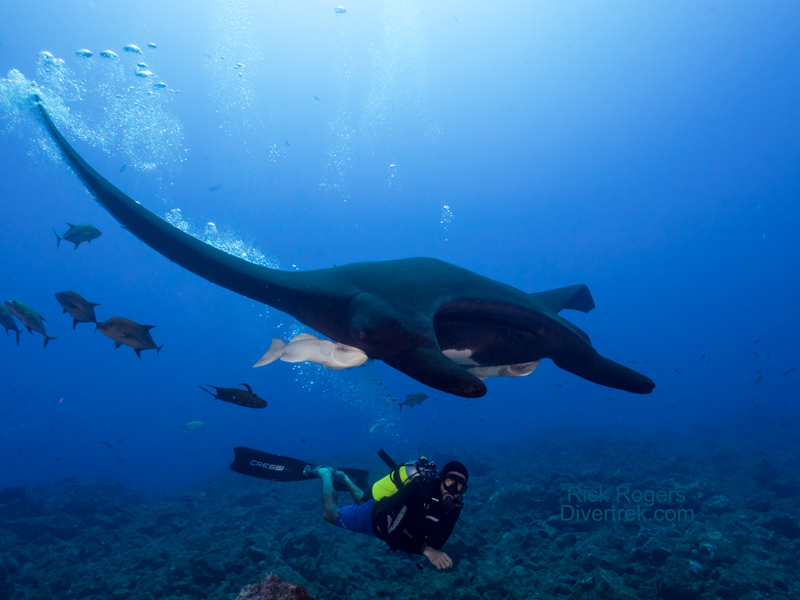
Giant Manta and diver at Socorro Islands.
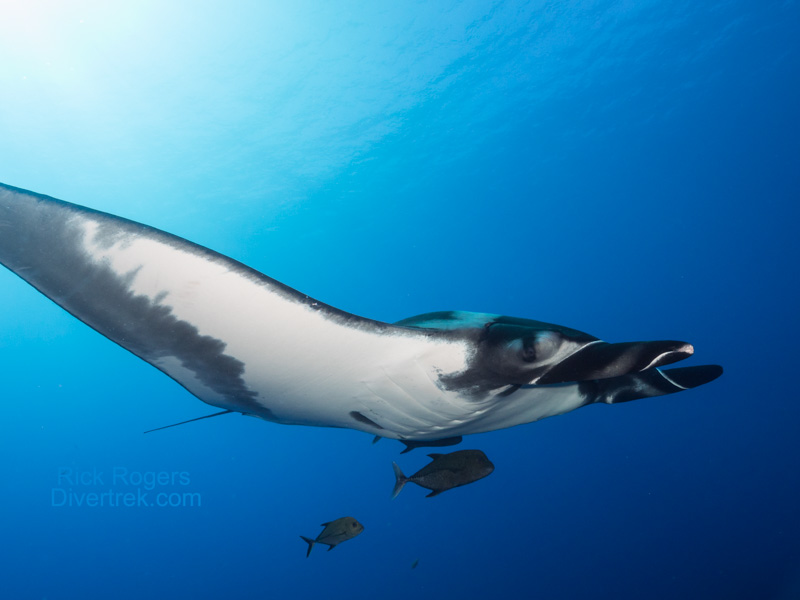
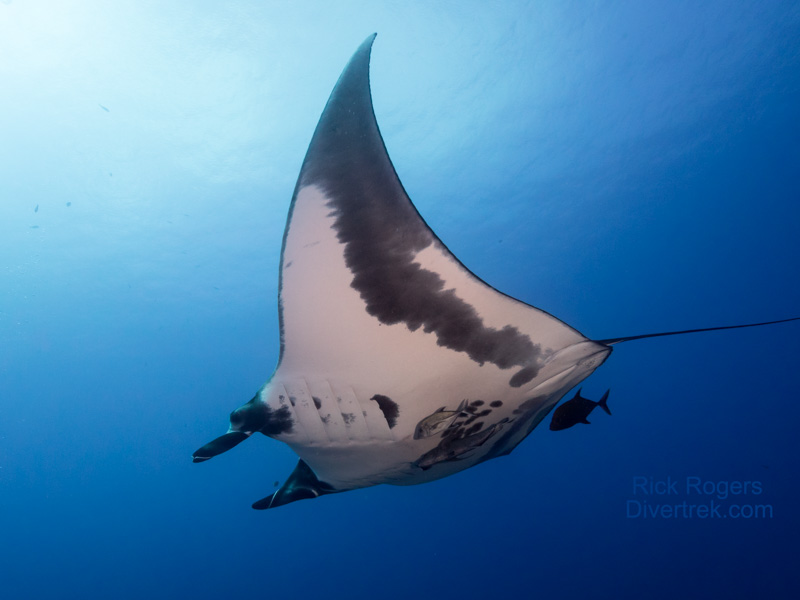
Gentle flying giants. The Oceanic Manta Rays at the Revillagigedo seek out interactions with divers, and particularly like their exhaust bubbles. They apparently enjoy the “tickle” against their skin.

January, 2020.

The Revillagigedo Archipelago- or more commonly, Socorro islands- is a group of four isolated volcanic remnants about 400 km (250 miles) Southwest of the Baja California peninsula in Mexico. The islands are like an oasis in the desert of the open ocean, attracting life, and supporting their own unique ecosystem. It’s the largest fully protected Marine Reserve in North America.

Rightfully known as the “Mexican Galapagos”, people from all over the world come here for their famous Giant Manta Ray, shark and dolphin encounters. Having heard a lot of good reports from other divers, I had to go see for myself.

The Revillagigedo Islands (pronounced Rev-ee-aa-he-hee-do) consist of a group of four islands: San Benedicto, Socorro, Roca Partita and Clarion. But usually only the first three are visited on week-long trips due to the extra day’s travel (one way) to the more remote Clarion. There are no permanent settlements on the Islands except for a small Naval detachment on Socorro, with a daylight airstrip.
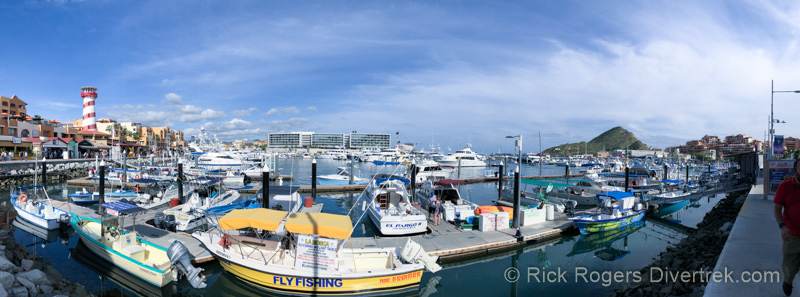
Marina Cabo San Lucas
Marina Cabo San Lucas, about 40 mins from the San Jose airport, where all the diving boats leave. This is a view from Captain Tony’s Bar & Grill, which I can highly recommend. The waterfront is lined with shops, drug stores, and restaurants. Be sure to walk to the end (at right in the photo) to the end at the boat ramp to meet Pancho and supporting cast. (see below)
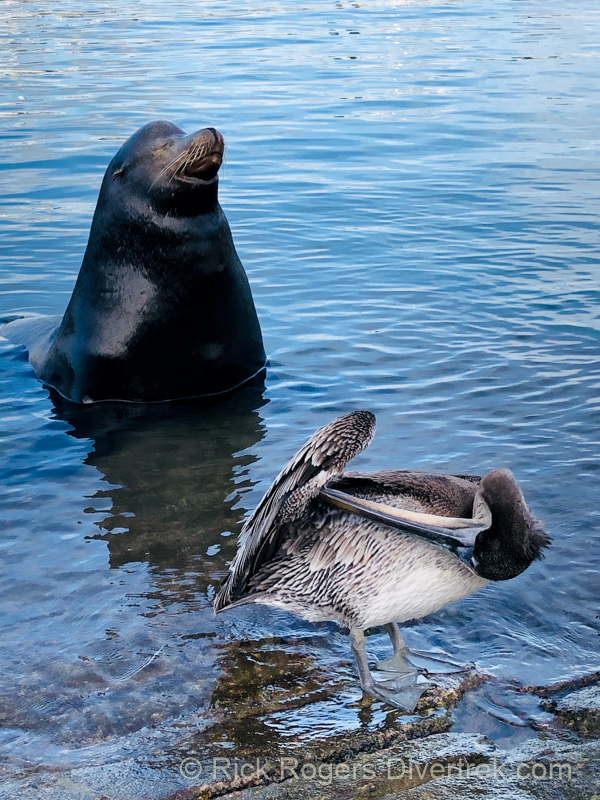
Pancho the sea lion at Cabo San Lucas Marina
Pancho with a full belly after being fed by some fisherman. He will command quite a crowd.

Due to the isolation of the Revillagigedo Islands, all diving is done from a liveaboard boat. We stayed on the Nautillus Belle Amie, one of the newer, largest and most comfortable of the boats at sea. The boat leaves the marina at 8 pm and takes about 24 hours to cross the Pacific to the islands. However it took us 26 hrs to cross to San Benedicto, since the Captain slowed the boat due to the waves to make it more comfortable for sleeping passengers.

Diving San Benedicto Island:

The boats only drop anchor and dive certain “hotspots” of life around the Islands that form established dive sites. Here are three of the well known dive sites at San Benedicto that we dived:
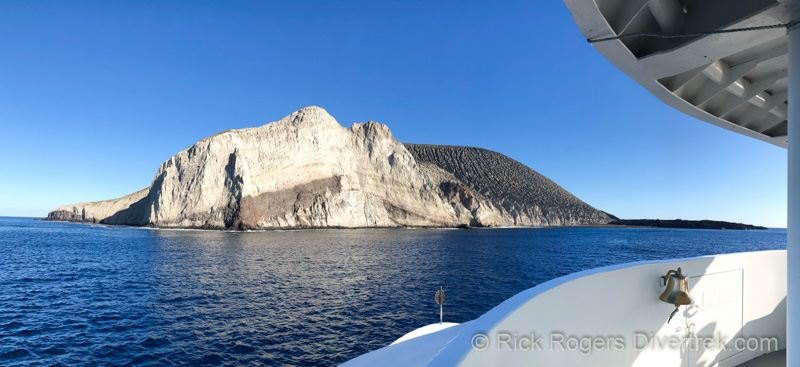
San Benedicto Island
View of the sheltered southern end of San Benedicto Island and its fascinating geology, from the upper deck. Its an extinct volcano that last erupted in the mid-1950’s, which can be seen as the dark coloured rock on the East side (right in the photo).
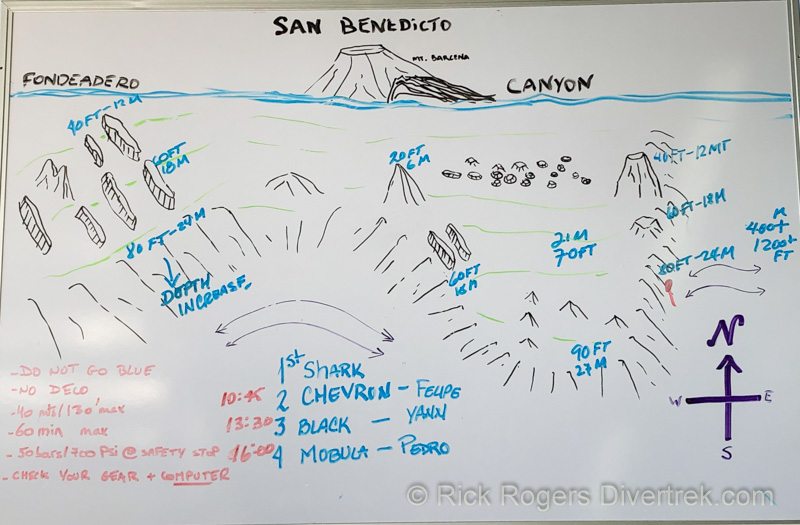
Dive site map at San Benedicto Island
The Dive briefing at San Benedicto. Compare with the photo above. The check-out dive was at left in the photo. The red buoy marker on the diagram (right center) is a monitored shark cleaning station. “Do not go blue” means no blue water drift diving (without a guide, SMB and chase boat).

Fondeadero is often used as a check out dive spot, as with us, since its usually calm and not too deep. We saw lots of fish, including some small Groupers, lobsters, and two small black tip reef sharks. But one group did a blue-water dive there and believed they had seen a Tiger at the limits of visibility.

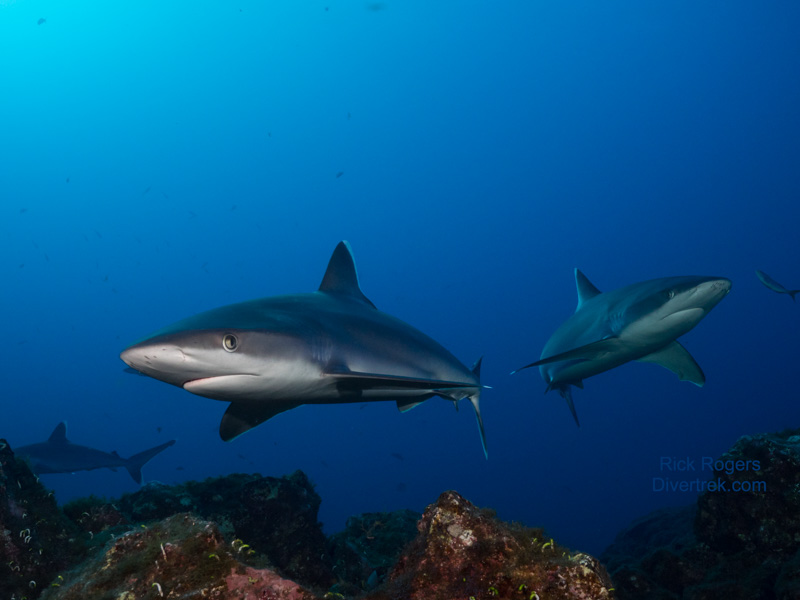
The Canyon reminded me of a semi-circular flat crater bounded by a ridge at the edges before the drop-off. We did the majority of our dives here due to conditions, which was no hardship! But just imagine that minutes into our first dive here we encountered two Mantas (see pics below)! We also always saw plenty of sharks here, including Silvertips, Galapagos, Scalloped Hammerheads and Silkies. On one dive we literally dropped down on top of a 10′ Tiger on the flat, but it got nervous of our group of six “aliens”, and quickly left, as they typically do. In fact I was told that Tiger sightings are becoming more frequent here as the biomass of the Marine Park continues to grow.
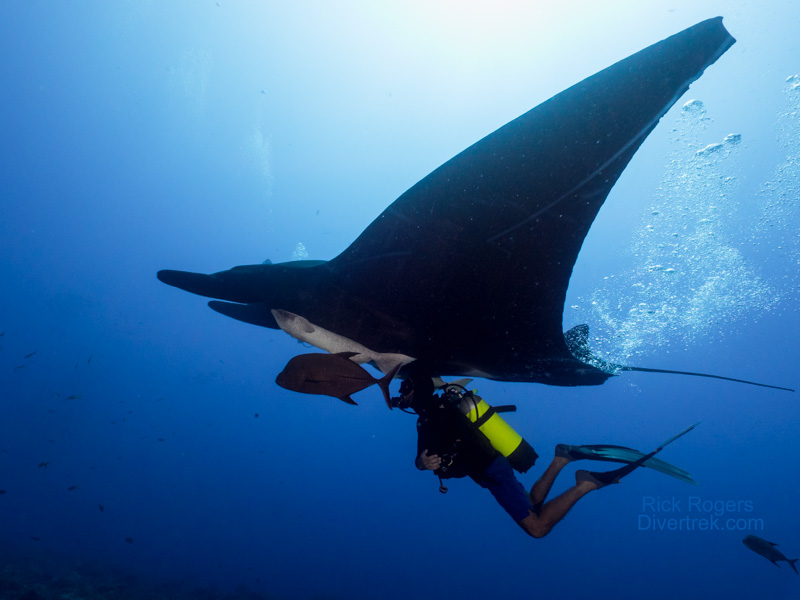
Giant Manta and diver at Revillagigedo Islands
This is how close you can get! Divemaster Thiago knows how to make friends with a Manta. It appeared as though the Manta knew him, and responded in kind. This is the same Black Manta as in the opening picture.
Close encounter with a Giant Manta Ray
What it look like when a Giant Manta Ray passes over your head! The secret to an interaction is to not chase them. Calmly remain at your spot and just wait for them to visit you. They will!
Close encounter with Giant Manta Ray at Revillagigedo Islands
They will also come and look you straight in the eye- a humbling and emotional experience. Manta Rays have the highest brain to body mass ratio of the fishes, and so are very intelligent. Experiments have even shown them to be self-aware, and therefore, sentient.
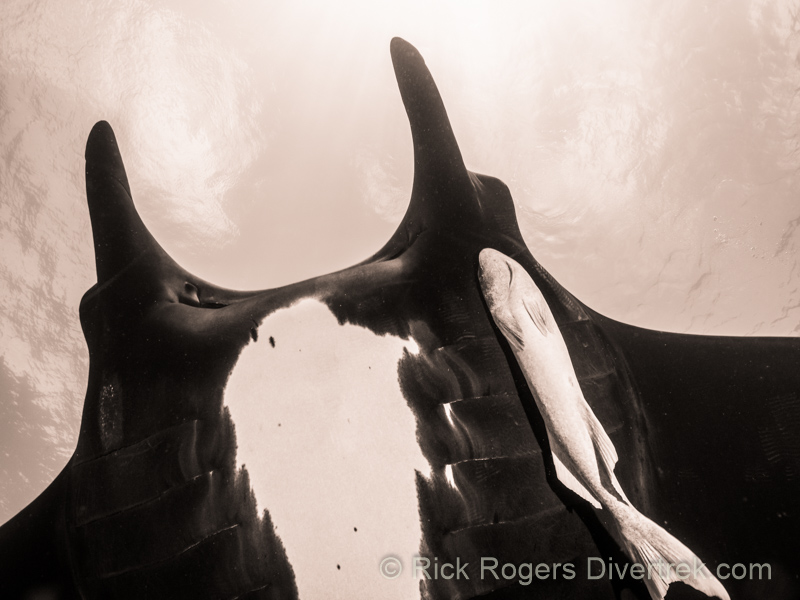
Giant Manta Ray
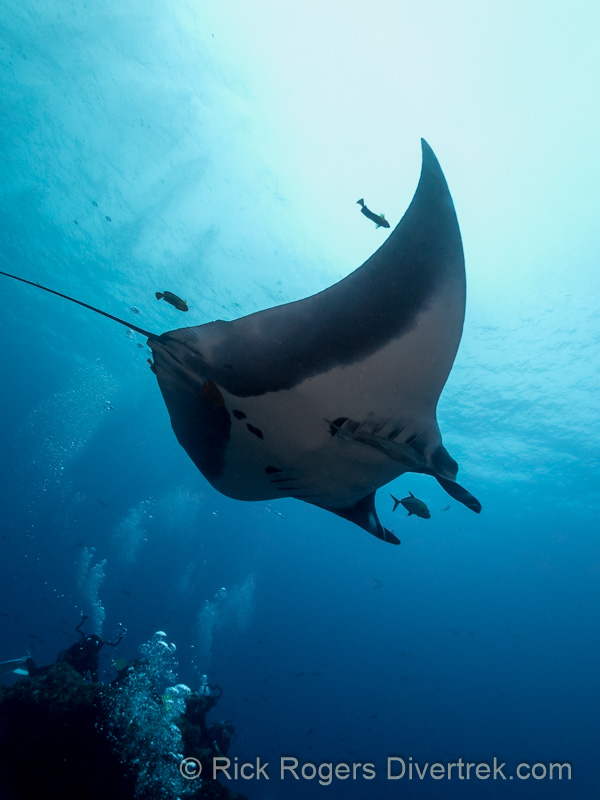
Such graceful and serene creatures in the way they move their wings and appear to fly. They photograph well from almost any angle. The markings on the bottom of the wings are as unique as a fingerprint, and can be used to identify individuals.

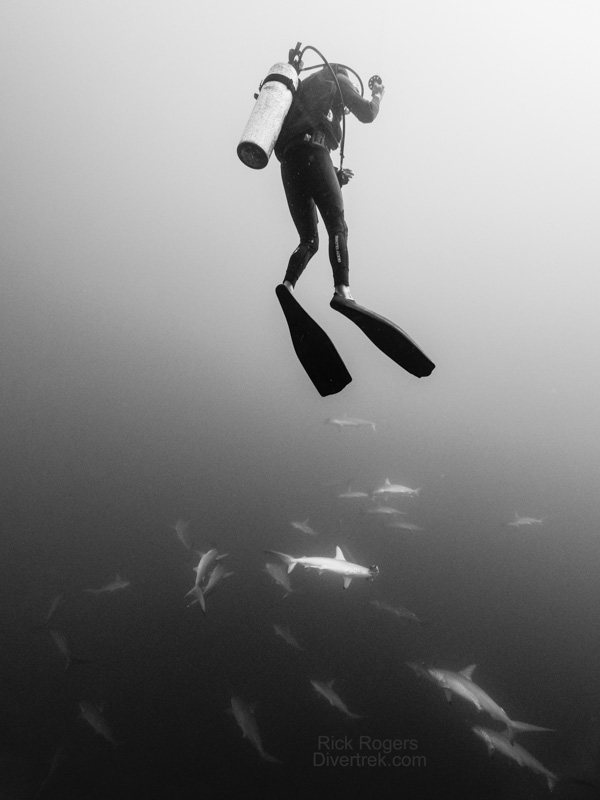
As special as the Manta encounters were here, you would think that the Island could deliver no more surprises. But four of us decided to do a “blue-water” drift dive off of the point (drifting East) and “roll the dice” to see what we might run into. Just minutes after descending we ran into a school of Scalloped Hammerheads below us at more than 100′ down! The school sent up a half-dozen or so sentinels to check us out, which came quite close. Then they “reported back” to the school.
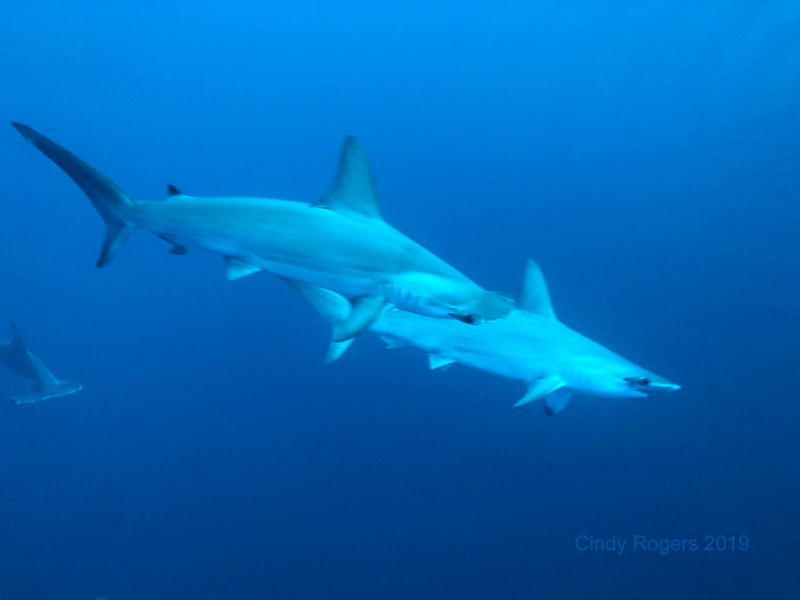
Scalloped hammerheads at Socorro Islands
The “sentinels” that investigated us. They came even closer still! (But I was too fixated on the school to notice them behind me. They’re so sneaky!) Captured in Program mode with an iPhone 8 in a Kraken housing, 4 mm iso 200 at f/1.8, 1/25 s.
Diver with school of Hammerheads at Revillagigedo Islands
One last glance. iso 1600 at 9 mm, f 7.1, 1/160 s. At the limits of our MOD and bottom time, I took this snap shot just before ascending to remember this moment. Sightings like this will likely become increasingly rare over the coming decades, as the IUCN recently declared Scalloped Hammerheads as Critically Endangered. That’s one step from extinction! The main cause for this decline being incidental bycatch in industrial fishing fleets. If you want to eat fish, and don’t know how it was caught, its best to leave it off your plate. Only consume fish from small-scale, local operations that use selective gear.
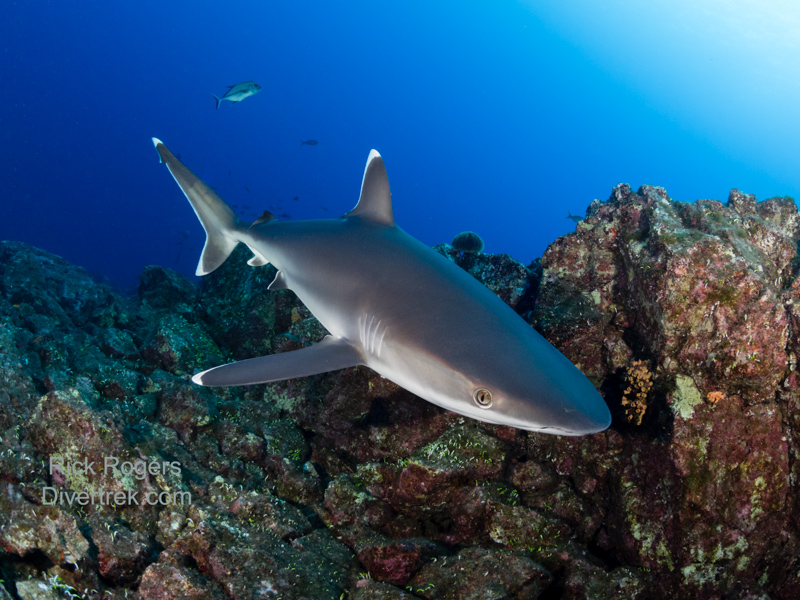
Silvertip shark close up.
A young, curious Silvertip comes in closer for better look.
silvertip sharks at cleaning station
We often found a group of young Silvertips at the cleaning station marked on the dive map above. Note the parasitic Copepods on their snouts, appearing as black streaks. Cleaning stations are where parasite-picking fish set-up shop to go to work.

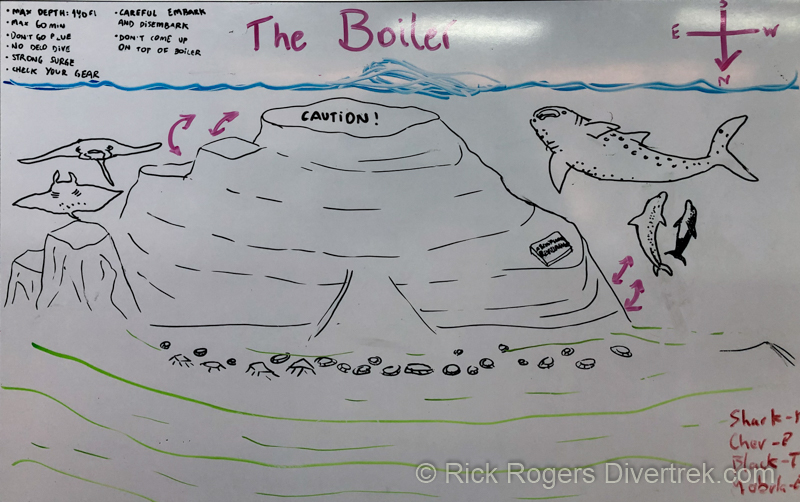
At the end of our trip, we attempted one dive at the world-famous “Boiler”, on the SW side of San Benedicto. It’s reputed to be the best place on the Earth for friendly Manta interactions. Although we did see dolphins and two different Mantas towards the end of the dive, the visibility was poor (about 20′) due to the past week’s weather.
The Boiler dive site map at Socorro islands
Dive site map of the Boiler. The name originates from the waves and swell breaking on top of the pinnacle, which rises to within 20′ of the surface, giving it the water the appearance of boiling. This is a well known Manta cleaning station, where you can often see them being cleaned by beautiful Clarion Angelfish.

Diving Roca Partida:

Roca Partida
Roca Partida is a lonely, guano-covered pinnacle in the middle of nowhere, about 135 km WSW from San Benedicto. But its a magnet for pelagics, and teeming with life underwater!

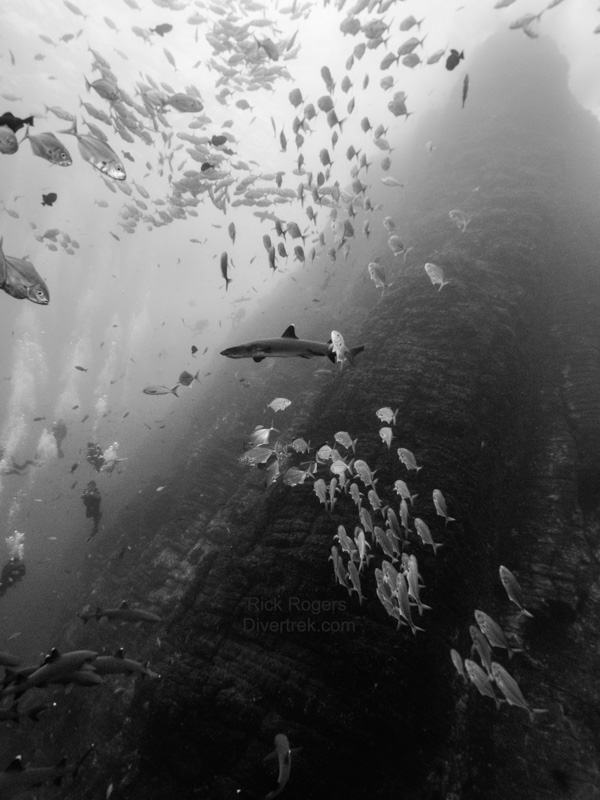
Because of an approaching front, the Captain decided to visit Roca Partida next to squeeze in a day’s diving before it got too rough. Normally they spend two days here, because of the richness of the site. It’s famous for its superabundant Whitetip Reef sharks, and dozens of them can be found resting on the balconies (bowl-shaped cavities) in the rock on the West side. Expect to see large schools of fish, and middle-predators like Jacks and Tunas hunting, and many other sharks. Mantas are also frequently seen here, and whale sharks when in season. The pinnacle can be circumnavigated in a single dive if the currents allow. A visually stunning site underwater!
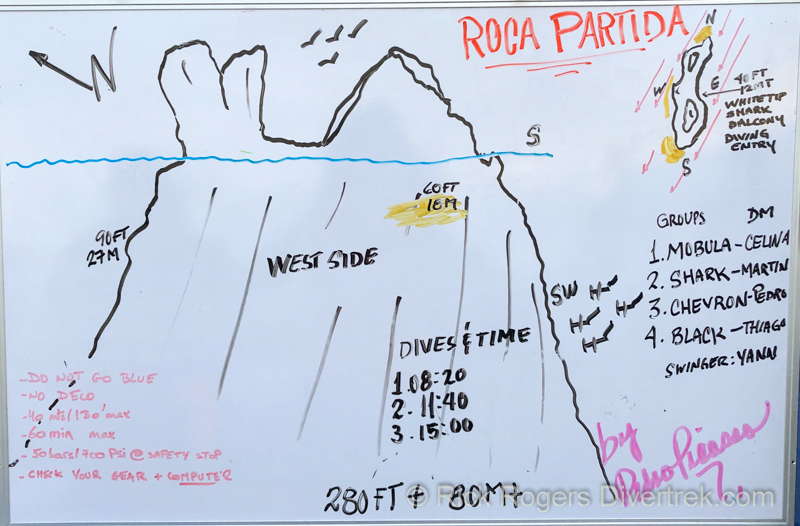
Roca Partida dive site map
Dive site map of Roca Partida. It can have strong currents, but on our dives it was minimal. However the surge near the pinnacle was a couple of meters.
whitetip reef sharks on balcony at Roca Partida
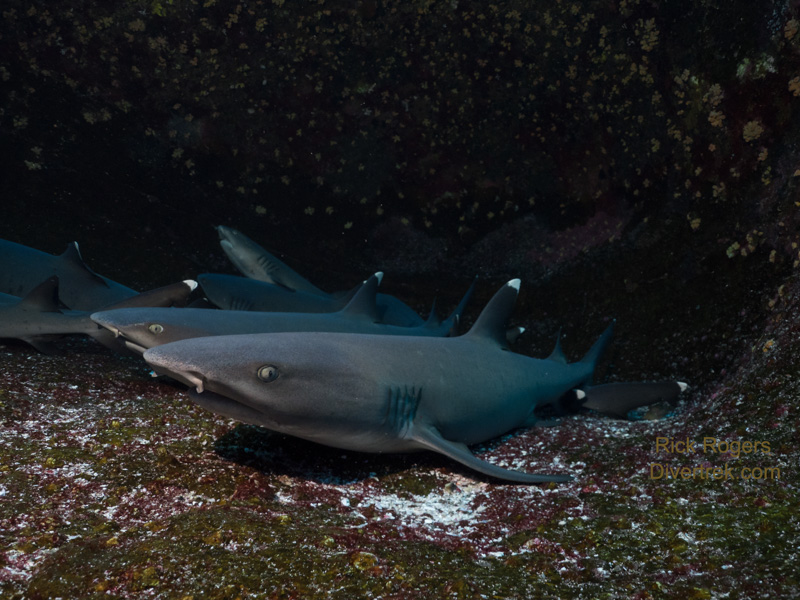
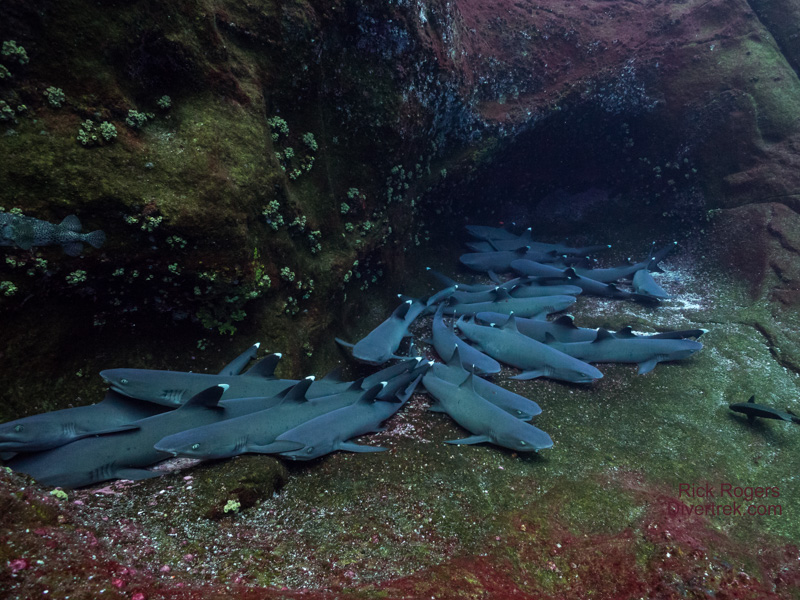
Count them! A natural light image of a large balcony full of twenty, resting Whitetip Reef sharks. The balconies are typically found in only 30-40′ depths. The surge was incredible here, so I had to be careful to not disturb the sharks, as the surge would sometimes try to push you into them.
group of resting whitetip reef sharks at Roca Partida
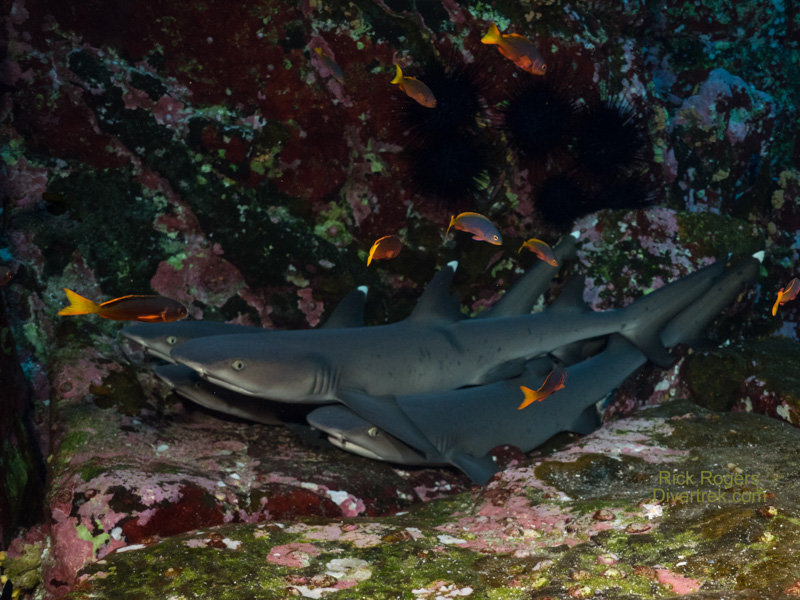
Resting after a long night of hunting, Whitetip reefsharks are nocturnal hunters, and come to these balconies to rest, and get out of the current.
resting whitetip reef shark at Roca Partida
Their “flattened” bodies, and short, wedge-shaped snouts are ideally suited for hunting prey in the holes, cracks and crevices of this type of terrain. They are remarkably tolerant of divers. Approach them slowly, and if they seem uncomfortable, just stop and wait. Let them get comfortable again before continuing.
school of whitetip reef sharks at Roca Partida
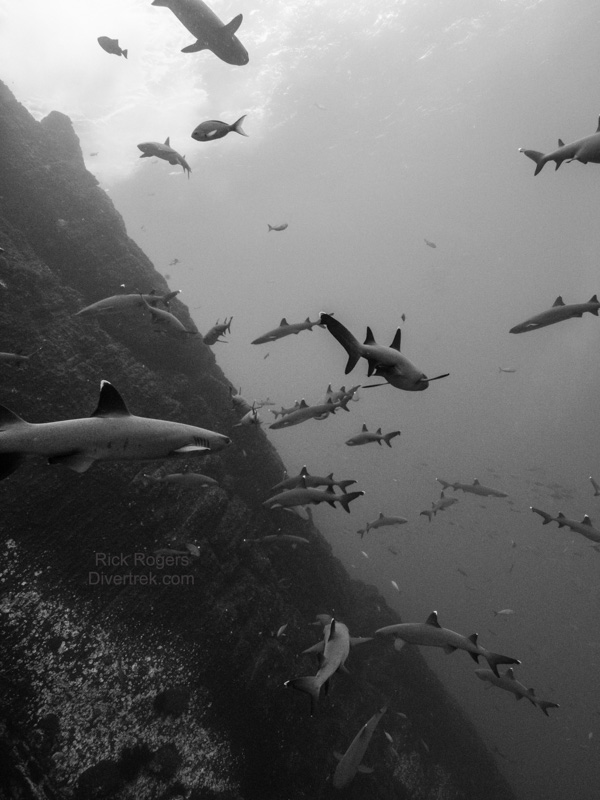
Drifting through a school of Whitetips around the North point.
Diving Roca Partida
If I had to choose only one image that would describe the diving at Roca Partida, this would be it.

Diving Socorro Island:

Socorro Island
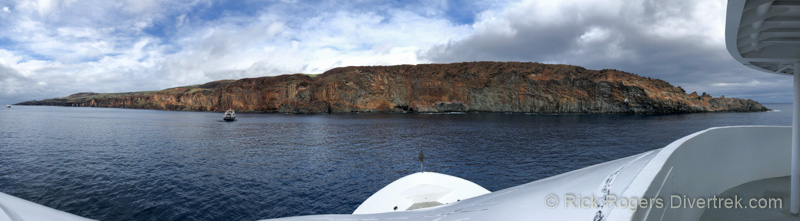
A panoramic view of Socorro Island at Cabo Pearce, sheltered on the SE side.

Socorro Island is the largest of the islands, and located about 117 km East of Roca Partida. This is where the boats go to check-in, get boarded and inspected by the Mexican Navy (west side). This process can take up to several hours, and you will have to give up a dive for it.

To make up for this loss of a dive the Belle Amie offers a unique, night snorkel with Silky sharks at Socorro. I have to admit that at first I was a little skeptical of this, as my experience with Silkies is that they can be very curious and add in the reduced visibility at nighttime and, well you get the idea. But after listening to the briefing, five of us decided to have a go, and the other twenty five decided to watch (and cheer and jeer!) from the stern. A Divemaster will join the group (a Park requirement).

The sharks that hang around the boat are small, about one meter. They are attracted to the Flying fish which are in turn drawn by the ambient light from the ship, especially bright lights. You can see the sharks at any given time at night splashing around and chasing them. But this is why you are no longer permitted to take a dive light with you, even mounted on a camera, as the Silkies behave more unpredictably when chasing prey. So you will have to photograph in ambient light, which is very difficult. I have included the photo below to give you an idea of the settings required.
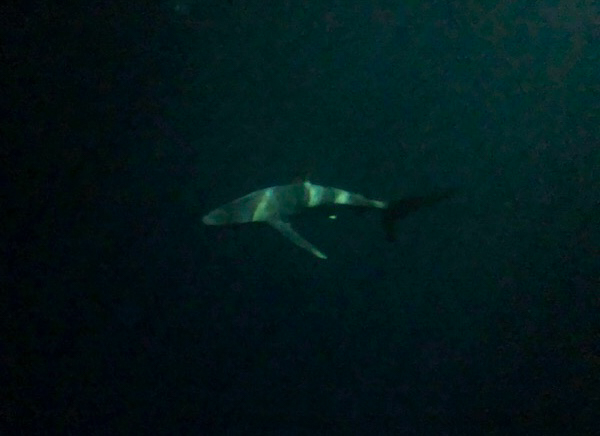
Night snorkel with Silky sharks on the Nautiillus Belle Amie
Silky shark on the night snorkel. Unedited photo, shot at 4mm with an iphone 8, iso 20 000, f/1.8 , 1/15 s in a Kraken housing. Photo courtesy of Cindy Rogers.

Any jitters that I had quickly dissipated once I slid into the water, and the experience actually became quite relaxing and meditative. The sharks will sometimes approach you closely-but never aggressively- and I had one come in and inspect my dome port. Give it a try!

Cabo Pearce dive site map on Socorro Island
Dive site map of Cabo Pearce. Cabo Pearce is another well known Manta hot spot (cleaning station). Dolphins are also commonly seen here as well.
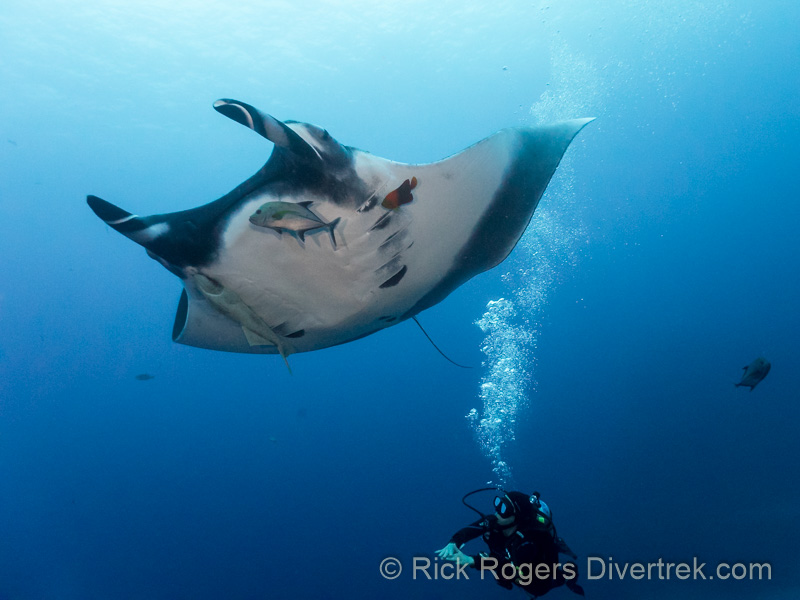
Giant Manta at Socorro Island
A Manta getting a “bubble bath” from all the concentrated divers’ exhaust bubbles. We saw two different ones that morning.
Giant Manta being cleaned
Spa treatment. This Manta is being cleaned by a Black Jack and a beautiful Clarion Angelfish, the bubbles are just a side benefit. Most of the world’s population of Clarion Angelfish reside here in the Revillagigiedo.
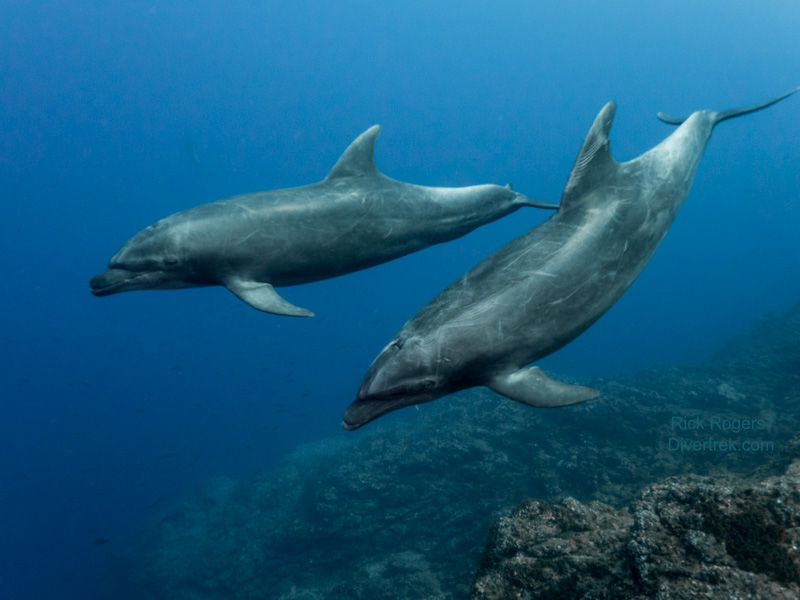
Dolphins at Socorro
Curious, playful, and fleeting. While we had dolphins at many of the sites, this was the first clear shot I could get of them. In this picture they calmly passed right by us and headed straight to a divemaster- whom they probably recognized -with his hands held out. If you don’t entertain them (how can you when you have a camera?), they’ll quickly leave.
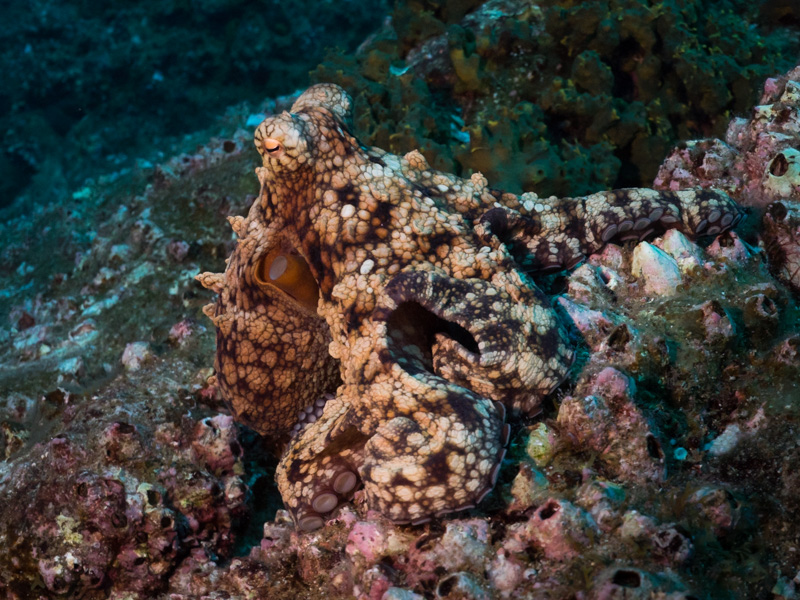
Octopus at Socorro Island
Sharks and Mantas get all the attention, but there’s lots more, like this Octopus at Cabo Pearce.

Tips:

The Nautillus Belle Amie is large, well appointed and built to cruise ship standards- safe, comfortable and roomy. I even had my own camera station! Nonetheless, bring your sea-sick medication if needed, as many guests still missed dives due to it. Satellite Wi-Fi is available for $100 USD but slow and sometimes spotty, depending on the number of guests using it.

It would be worth some time checking the other boats’ schedules, to find the most optimal, “off-peak” time for your visit. There are a lot of boats visiting this area now, and the unfortunate reality is that more people means less wildlife. During the rough weather we had as many as four other boats vying for the sheltered dive spots, resulting in schedules and line-ups, and over-lapping dives.

Questions or comments? Join me on instagram @rogers_r2.

Close Menu