
August, 2015

Imagine a place so diverse and dense with life that it is literally stacked on top of each other. You’re surrounded by emerald green coloured water on one side and on the other by sheer white coloured walls studded with kaleidiscopically coloured sponges, anenomes, and fishes. In between dives you will absorb beautifully rugged scenery, and there’s a good chance that you will see one or more stellar sea lions, sea otters, whales, dolphins, porpoises or even orcas. It’s virtually untouched and you’re most often the only ones out on the water. That place is God’s Pocket, British Columbia.

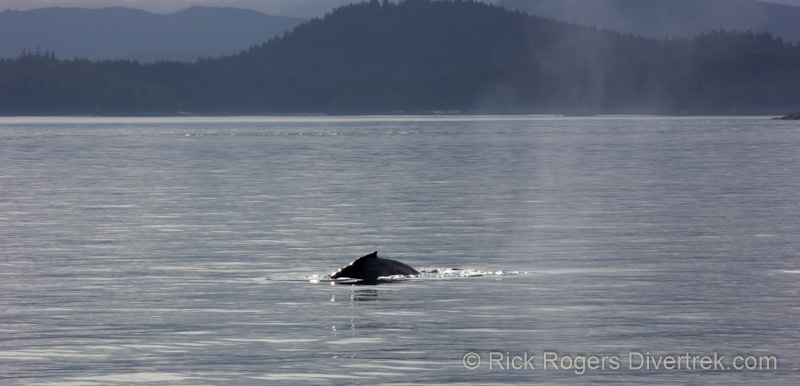
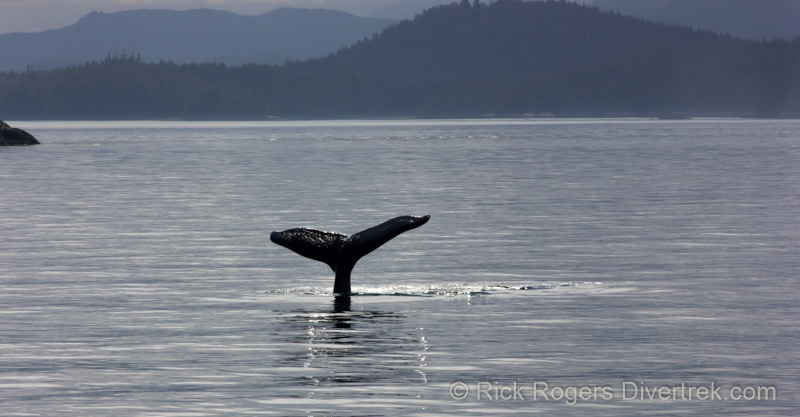
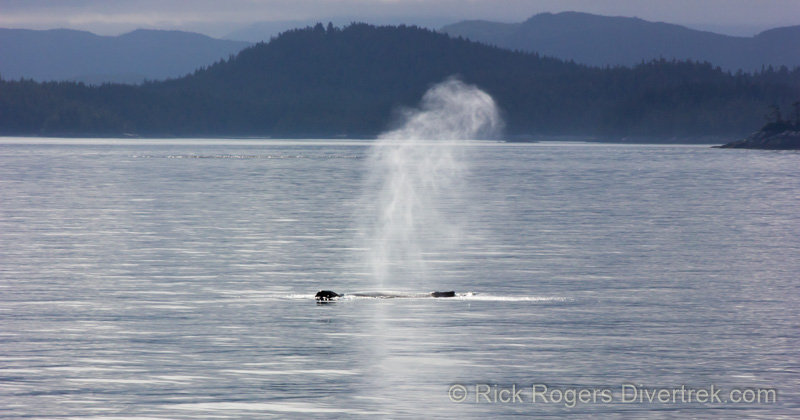
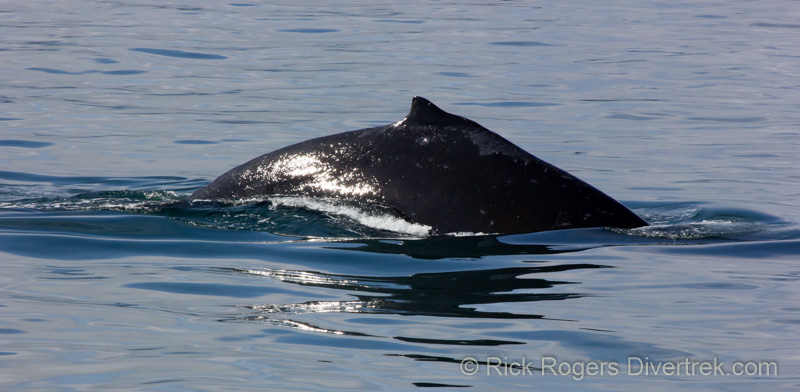
Having learned the hard way before with the uncertainty of air travel and other delays, we arrived a day early. We used that lead time to do a whale watching tour with “Stubbs Island Whale Watching” at picturesque Telegraph Cove, about a 45 min drive south of Port Hardy. This is a great way to see some wildlife, and the beautifully rugged coastline of British Columbia. They have a comfortable two-tiered boat, with experienced captains that will narrate your three hour tour. Also onboard is a professional naturalist that will explain the biology, history and contemporary issues faced by the local marine inhabitants using pictures, placards, models and a hydrophone. They are also enthusiastic to answer any questions you might have.
Here are some photos from that tour. I found a 75-375 mm telephoto lens very handy (for the whale-watching, and for surface intervals after diving), and often used a shutter speed of 1/1000th of a second (to make sure I compensated for camera shake, the boat’s motion, and the animal’s motion).
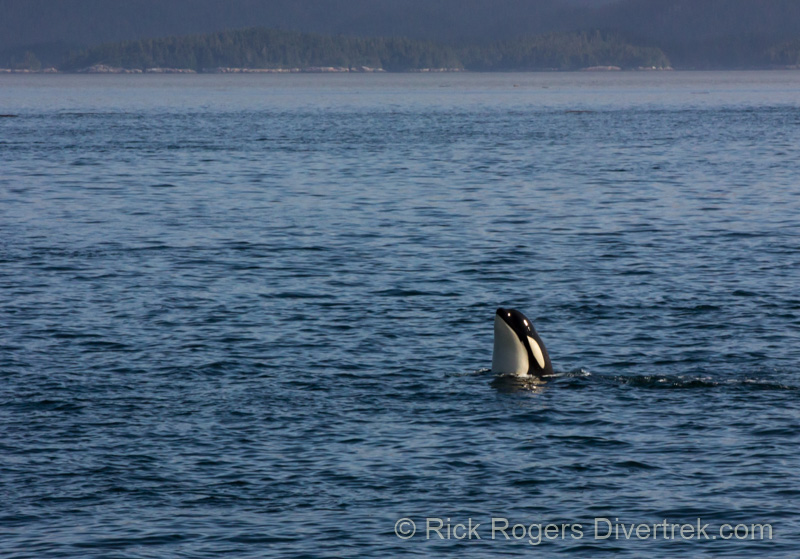
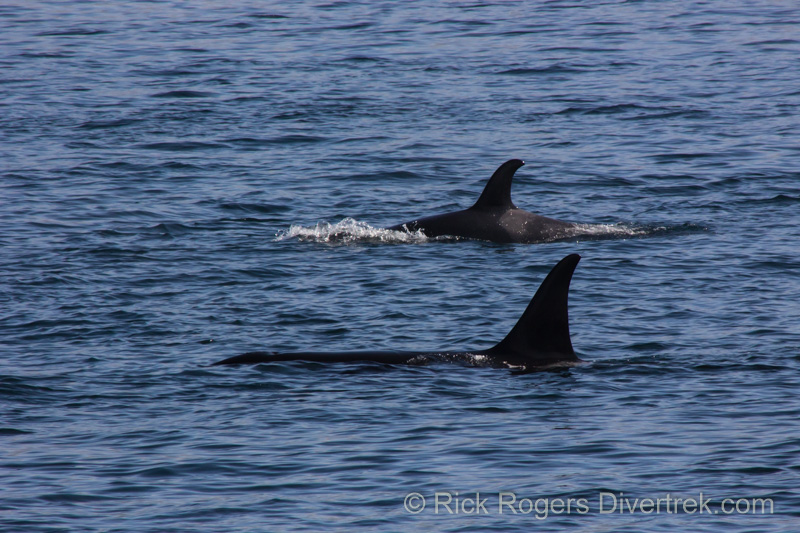


“God’s Pocket” references both a Marine Provincial Park and a “pocket-shaped” protective cove on Hurst Island where the resort is located. Nineteenth century fisherman gave the cove its name owing to it being the safest shelter short of Port Hardy, about 16 km south. But most of the diving you will do is in the neighbouring Browning Pass.

Cold up-welling currents from the deep ocean bring nutrient rich waters to the coastline of British Columbia, resulting in water temperatures consistently in the 50 degree F. range. This nutrient rich water is continually fed through current-swept passageways which supports a very rich marine life, and world class diving. So different was the wildlife from any of my previous experience that diving it was a renewing experience- a thrill each and every dive. It was like diving all over again for the first time.


The visibility varied any where from 20 to 60 feet, with an average of 30-40 feet. As Bill (one of the owners) explained to me, the visibility is more site specific and tidal dependent than seasonal, as people often mistakenly think. I can personally verify this. On a mid-day dive at “Landslide” under clear skies with the sun up high at slack tide, we had up to 60′ visibility. On a late afternoon dive at the same site, the visibility had dropped to a maximum of 20′, due to afternoon shade, and an ebbing tide. Flooding tides generally bring better visibility. But even with the poorer visibility, there’s so much to see down there that you don’t really notice it! The typical dive profiles are 60′ or less. As you will see in the photos below, life is abundant and everywhere.


Because of the limited light due to particulates (and even jellyfish), be prepared to bump up the ISO of your camera to as high as 640, or even 800. Lighter coloured backgrounds can hide the backscatter and ever-present particulates. Compact camera users definitely have the advantage here, as they can switch between wide angle and macro on the same dive, to suit conditions and photographic opportunities as they arise.

One of the reasons that I wanted to dive B.C. was to see Wolf Eels. While it’s possible to see them anywhere in the Browning Pass, the most reliable place to encounter them is at “Fantasy Island”. The reason for this is that there are several resident “families” there, and they’re known to occupy dens for years. Quoting one divemaster, “You have to be blind not to see one here”. It’s an exposed and isolated site-and not much of an island-but it is really just a pinnacle that barely breaks the surface of the water. The top is surrounded with bull kelp, and it plunges vertically to about 60′ where it then splays out into a rocky base that provides the perfect habitat for Wolf Eels. Look for the Wolf eels there, moving deeper if you have to. Don’t worry, there’s enough of them there for everyone, so don’t crowd the first one that you see. And contrary to what their name suggests, Wolf Eels are neither eels nor “bad-tempered” (quite the opposite in fact).


As you can see from the Wolf Eels, the majority of fish here depend on camouflage for defense. And like the Caribbean, they’re every bit as unique and beautifully coloured and patterned. I discovered that the Irish Lord is so confident in it’s camouflage that you can approach it very closely, practically touching it. They are capable of slowly changing their colours to blend into their background:


Another option that you might have is to dive with Stellar Sea Lions at “Barry’s Island”. The island itself is not an active rookery, but it is surrounded by them. Here the sea lions have the option to join you or not, at their choosing. Bill gave us the heads-up about what to expect: they sometimes tug at your fins, and “mouth” parts of you, and in general just plain “harass” you in a comical way. We were warned to take off any snorkels, for obvious reasons.


Some sea lions did come over to us. They were there in the water as we geared up. But when we hit the water, they seemed to disappear without a trace. No one even glimpsed one underwater. But the wall around Barry’s island is beautiful to explore. And if you go deep and outward from the wall (take a reciprocal compass bearing, just in case) to some neighbouring mounds, you can see fields of beautiful Pink Gorgonians, which are often only found deeper (below 50′).


But the real encounter that I was looking for all week was a meeting with the “King of the Browning Pass”, the Giant Pacific Octopus. It was the reason I was reluctant to take off my wide angle lens (when Murphy’s Laws would surely strike) for the whole week. Every experienced diver has interesting and funny stories to tell about these highly intelligent animals. See Jackie Hilderings blog for examples, and Octpous information. Finally, on the second last dive of the week, my dive buddy (Cindy) found one, a small one with the head about the size of a basketball. We hung around for a few minutes to let it get comfortable with our presence, then I snapped some shots. Cindy extended a gloved finger toward the Octopus, and it reciprocated by moving its arm to touch her in a moment of unspoken inter-species communication. She could feel the suctioning through her gloves. Excited, and awed, we then left the Octopus to get on with its busy life. My trip was now complete!

Although I shot with my “work horse” 9-18 mm wide angle lens, other divers chose to shoot macro exclusively. And for good reason-the area teems with macro life. For some beautiful macro photographs by a fellow trip participant, Merry Passage, see:
Molluscs and Others of British Columbia
Tips:
The jumping point for the start of your trip to God’s Pocket is Port Hardy, where the resort will pick you up. To get there you have two choices. The first is by a one hour connector flight from Vancouver (we used Pacific Coastal Airlines). My dive buddy and I had to co-pay for an extra “baggage seat” to accommodate our gear. The other choice is by a two hour ferry crossing from Vancouver to the Victoria, and then at least a 4 hour car drive to Port Hardy. Note that you will not always have cell phone coverage along that highway.
Once at the Port Hardy airport, you can get a car rental there if required. If you’re staying overnight I highly recommend staying with Alfons at “Escape Bed and Breakfast”, located within walking distance of the Port Hardy airport. You’ll quickly feel welcome and at home, and he’s more than helpful. He’s a Chef and a photographer, and his B & B is adorned with his beautiful photographic art. Alfons can also get you a quick window-seat reservation at the very popular “Sporty’s” for dinner, over-looking the waterfront, where he works.

God’s Pocket resort gets a 5 star rating in my books. The cabin we stayed in had privacy, scenic views, was very comfortable, and had all new amenities (with separate bathroom and shower). The owners, Bill and Annie, will leave you without want for the length of your stay. The meals were always exceptional and were something to look forward to after getting out of the cold water. You will get three dives per day. As every effort is made to dive during slack water, the dive times vary depending on the tides. Bill has dived and operated in this area for 25 years, so he knows how to read the water, where to go, and how best to dive it (verbal instructions are given). It’s all wall diving here. You have to be self-reliant and have the confidence to dive your own profile, do your own navigation (simple), with total independence (which I love). Since the temperatures were 50-52 deg. F a dry suit is a must. Sites are not moored, and you have to make free ascents/descents, and the boat will pick you up where you surface.

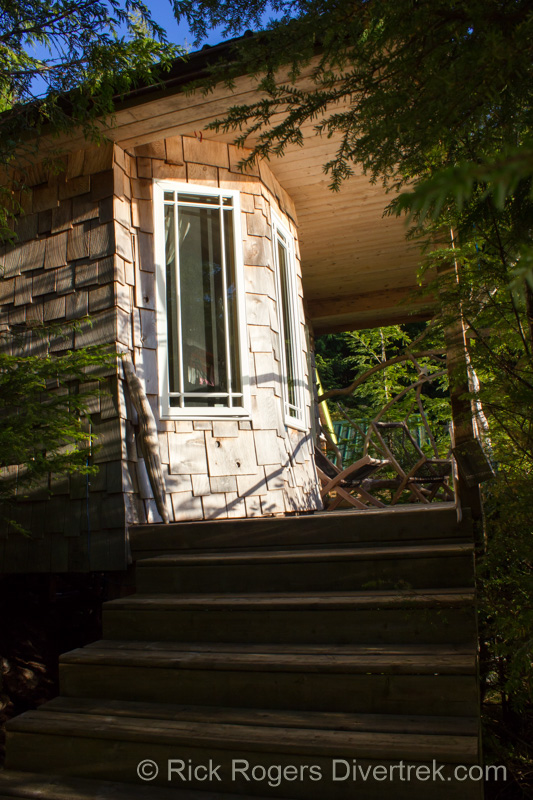
Would I go back? I’ve already booked it again for next year, for the specific purpose of diving the Nakwakto Rapids, and with more days of diving!
References:
An indispensable guide to the wildlife in the Pacific Northwest is the book by Lamb A. & Hanby B., 2005, “Marine Life of the Pacific Northwest: A photographic Encylopedia of Invertebraetes, Seaweeds and Selected fishes.”, Harbour Publishing.